Monthly Archives: September 2011

Good News!

We are not PREGNANT!  (In addition to enjoying my capitalization decisions, I would like to take a moment to note that whenever a young married couple has good news that has nothing to do with procreation, it can be, for many, disappointing good news.  My good news, alas, is of this type.)
First, I got a job at Habitat for Humanity International, and I am about to finish my first week.  I’m the new CEO.  Seriously, they were all very impressed with my community organizing skills and lightning-quick reflexes. Or, I’m working in the office of the CEO as a Strategic Planning Intern (fortunately it’s a paid position) tasked with, you guessed it, working on their new 5-year strategic plan.  But I do love my endearingly ambiguous plaque.

I am very excited about the job and the people I am working with.  I enjoy how intelligent everyone is, how fast-paced everything is, the enormous amount of talent and experience at the table, and the incredible responsibility; it’s great.  It can also be overwhelming.  Pray for me.  I sometimes sense I am drinking water from a fire hose.  Habitat is a huge and complex organization.  But I seem to have found some footing today, and I think that, in addition to learning a lot and making great connections, I might have one or two things to contribute.  Also, attempting to drink from a fire hose sounds like something I would try.  : )

Secondly, two weeks before I got the Habitat job, I signed a traditional contract with a prominent literary agent.  I am very excited about that as well.  He has been in the business a long time, knows what he is doing, and I trust him.  He is going to be able to open some doors for me, and he has already helped me sharpen my proposal.

Thanks for all those who have been so supportive over the past year.  We really appreciate it.  Though I expect to stay busy, I hope to keep posting on a weekly basis (maybe Wednesday mornings?), but we will see if that happens.  This blog is a good outlet for my vast nerdlike tendencies.  A post of epic proportions has been brewing in the recesses of my mind which connects Malcolm Gladwell, Guns Germs and Steel, and Michelle Bachman.  We’ll see what comes of that!

In other news: Alicia is really loving her classes; she is swamped with different development projects, and she and I just celebrated 3 years of marriage!  Also, we will be in Buffalo Oct. 20th to 23rd.


Churchill, Stalin, and FDR

I’ve been on a WWII and Winston Churchill binge lately, which, God willing, should continue.  I have another Churchill biography to read and a lecture series on the British Empire and Commonwealth 1901-present.  What a wonderful life I lead!  Here are a couple of things that have become clear to me:

1)  Churchill, while being quite extraordinary, and while I relate to him quite a bit, was also obnoxiously imperialistic.  Bear in mind, a huge reason for his unpopularity in the decade preceding WWII was his condemnation of Ghandhi and his desire to hang on to India as an imperial possession no matter what.  Thus, Churchill’s goal in WWII was to a) win the war and b) preserve the British Empire and imperial power.  This annoyed FDR, and allowed FDR to kinda lump him in with Hitler and Stalin.  In FDR’s mind, they were all obnoxiously old school in just wanting to take other countries over–an impulsive old world tendency.

2) FDR, however, totally screwed up in judging Stalin, and Churchill more or less read Stalin right.  For instance, Churchill was very aware of Stalin’s post war ambitions of controlling half of Europe.  This is why Churchill wanted to come up through the Greece, the Balkans, and Italy, and attack the soft underbelly of the Germans, instead of landing on the well defended beaches of Normandy.  This different tack would have served two purposes: it would open up the second front that the Russians badly needed, and it would stop the Russians from making an enormous land grab in Eastern Europe.  This makes sense to me.  If I could, I would want to help the Russians defeat Germany, but not help them conquer other nations.  Obviously, Stalin wanted the Normandy invasion.  This is how things stood at the beginning of the Tehran Conference, the first time all three men would meet together.  FDR, who seems to have possessed the power to swing the decision either way, chose to give everything to Stalin, in the hopes that such extravagance would woo him over.  Not only would America and Great Britain commit primarily to Operation Overlord (the Normandy invasion), they would also pull troops away from the wonderfully successful campaign in Italy, troops that could have peeled north and east from Trieste, as one American 3-star general wanted, and how Churchill wished.  Instead, these troops from the Italian campaign would concurrently invade southern France (the Riviera).  In this way, and in many others, FDR acquiesced to Stalin in hopes of wooing him.  The only time that I know of that FDR stands up to Stalin with some harsh words is when, during the final stages of the war as both armies were squeezing Hitler, one German general sent feelers to the British and American armies as a precursur to surrender.  Stalin actually accused the British and Americans of looking to sign an immediate peace treaty so that the Germans could turn, halt, and reverse the Soviet advance.  In retrospect, maybe that was not a bad idea : ) but yeah…that was not the case at all.

3)  What makes FDR’s read on Stalin all the more unacceptable is that Stalin could have just as easily come into the war on the side of Germany than against it.  Thank God Hitler made an enormous tactical error and invaded in June 1941.  Before that invasion, Hitler and Stalin had been carving up Europe.  First, they split Poland.  Then Russia attacks Finland unprovoked (BTW, this campaign went awfully for the Soviets.  They only took a little territory, killed 70,000 while losing 330,000 of their own.  Also, Stalin got so mad he killed all the Generals involved.  Hitler later commented to an aide that it is wonderful to fight an enemy who kills his own generals for you.  It reminds me when Athens, in the last stages of the Peloponnesian War, had 10 of its admirals executed for not burying the dead quickly enough, and they had even won the battle!)  Then Stalin took Lithuania, Latvia, and Estonia, and two provinces in northern Romania.  The point is this: Stalin was just as ruthless, merciless, imperialistic, and aggressive as Hitler was.  FDR was dumb to give stuff away to him.

4) Sometimes we forget this, but only six months after the Germans invaded the Russians, Japan attacked Pearl Harbor.  I think this highlights the point that Great Britain was quite alone for a long time and deserve, in my mind at least, most of the credit for stopping Hitler from taking over the world.  They entered the war after giving the Germans an ultimatum after their expansion into Poland.  In other words, they chose to fight because they thought it was the right thing to do.  America, along with Russia, fought because they were attacked first.  Also, thank goodness Japan attacked Pearl Harbor!  Of course, the event was horrible, but it did finally push America into a war that it would have had to fight, sooner or later, and they got in while it was still winnable.

5) Having said all that, I do kinda wish that FDR would have lived for the post-war reconstruction and international realignment.  Even if he did not understand Stalin, he seemed to realize he was wrong towards the end, and FDR was brilliant.  In some ways, it feels like when we lost Lincoln after the War of Northern Aggression (yup!  I said it).  However, though I need to study it further, I think Truman would have been more up to the job than FDR, even if FDR was healthy.  But that, as opposed to everything that I say above, is just conjecture.

Thanks for reading!  Next time I will have some thoughts on Guns, Germs, and Steel by Jared Diamond.  That is a fantastic book.


Inspiration Oak

In 1492, the day before Christopher Columbus stepped onto the wet sandy beach of a new world he thought was India, a very insignificant event took place.   If Columbus would have kept going east, past the bahamas, over the gulf stream, and around the Florida peninsula, he might have discovered it–a fresh, tiny, young shoot that had just broken through the topsoil of an entirely pre-european continent.   Of course, Columbus, or anyone really, would not have cared, and would have easily and indifferently trampled it underfoot.  But, over the next few years, this shoot managed to avoid getting trampled or blown over by storms.  It grew in that little piece of what is today Alabama that juts down to the sea between Florida and Mississippi.  The plants there suffer through hurricanes at least once every few years.  But this little live oak survived.

In its youth, the world around it likely changed little, but in fact it had been claimed by a Spanish king.  It grew into a sturdy tree and endured more hurricanes, droughts, and fires, and Native Americans would stop and rest in its shade.

In its 27th year, in 1519, Cortez landed in Mexico.

In its 129th year, not too far away, Pilgrims and Native Americans shared the first Thanksgiving feast.

In its 284th year, in 1776, some self-evident truths were declared.

In its 327th year, in 1819, its ownership was transferred by the Spanish King to a young United States of America, and it became part of the new state of Alabama.

In its 373rd year, General Robert E. Lee surrendered in an obscure courthouse.

In its 453rd year, on V-J Day, August 14th, 1945, this picture was taken: 

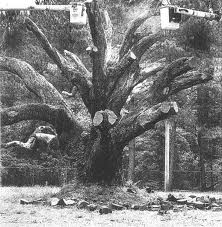
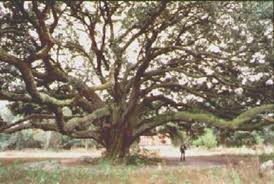
Twenty two years later, in the oak’s 485th year, this picture was taken of the live oak itself:

At this point the Oak, now called Inspiration Oak, had become famous and a hallmark of Baldwin County.  Though it was owned privately, Baldwin County was going through the process of buying the land for the use as a public park.  The owner was outraged at how little the County offered for the property, and purportedly was the one who, late one night, took a chain saw, and cut a ring through the bark all the way around the tree.   The community was devastated, but A Save the Tree committee was formed, thousands of doallars were raised, foresters were brought in to attempt to graft bark across the gash, AmeriCorps members organized the community, Tibetan monks came and blessed the live oak, and 15,000 visitors came a month to watch the ongoing effort to save the tree.  But it was no use.  The tree was dying.

In the Oak’s 509th year, around 9/11/2001 when our country was the victim of international terrorism, the tree died.

Two years later, in 2003, in the oak’s 511th year, the tree had become too much of a safety hazard, and it was cut down:


What’s my point?  I am not sure.  History is cool…and I like big trees…and I like old things.

JRR Tolkien loved trees. Anyone who loves history, age, myth, and all things ancient has to adore trees.  I love how they are so incredibly tied to their communities.  They are 100% committed.  They cannot move.  In the Silmarillion, the god of the trees makes Ents to protect these huge, ancient, and helpless creatures.  In the real world, Ents do not exist, and even if they did, they would be ineffective.  Humans are incredibly powerful, and can destory so much so quickly, with war, hijacked planes, or chainsaws.  We must do what we can to protect all valuable and helpless things.  Many of those valuable objects are that which connect us to our past.

I stumbled upon the Inspiration Oak story as I was looking through some of Habitat’s old National Service files a few months ago, and, for me, it immediately became a precious, rare connection to a pre-european America.  Its passing feels something like hearing that a WWI veteran died.   It strikes me in the face; so much of the past was not so long ago, and so much of what was not so long ago lives today in our homes for Seniors, our forests, and everywhere we look.  We really need to just keep our eyes open.

Beauty, specifically really cool history stuff, is everywhere.


The Modern Male Malaise

Nationwide, boys have poorer reading scores than girls, they are five times more likely to commit suicide, two and a half times more likely to drop out of high school, and, as of 2008, women accounted for 59% of all those enrolled in graduate school.  In January of 2010, for the first time in history, America had more women in its workforce than men.   There are now more females in med school and law school, two traditionally male-dominated professions.

This is not yet a tsunami.  There are different ways to look at the numbers.  For instance, more men still graduate from four-year colleges (29.5% of males versus 28% of females).  But trend projections make it seem likely that will soon change too.  In all, the image surfaces of western women on the rise and western men on the decline.

Now why is this happening?

I think there are a number of reasons.  First, people I trust tell me that the educational system disadvantages men.  It has something to do with how boys learn and how girls are better verbal processors sooner.  Secondly, I fault the lingering momentum of feminism.  Societal change has come about so quickly that many, especially those in the older generation, have not realized that it happened, and so they continue to advocate for the empowerment of women generally and everywhere as if they were still living in the 1950s.  I am for the empowerment of women, very much so.  But in broad sections of American society today, feminism is not necessary anymore.  In fact, it can be hurtful.  Generalized prescriptions quickly become stupid in a world and a country as large and complex as ours.

But what really interests me is another factor which is rarely discussed and seems to draw some ire.  It has to do with the relative uselessness of physical strength today.  Of course, strength is still useful for a number of things.  After all, boxes need to be moved and jars need to be opened.  However, such relatively meaningless activities serve to underscore how truly unimportant strength has become, especially when one ponders, just for a minute, how important it used to be.  Here we enter an alien world: the vast majority of human history.

In a world without guns, police, and communication technology, nearly all of the population existed in a state of what might be called quasi-anarchy.  Roving tribes attacked each other and the governments that did exist were not overly committed to protecting civil rights.  If you lived anywhere you likely lived within a tribe.  You would be completely reliant on the strong individuals in your tribe, specifically in your immediate family, to protect you, from wild animals, bandits, other tribes, etc., and those that could provide security naturally enjoyed a place of social prominence.

This old world was much closer to the state of nature that worried Thomas Hobbes, where life is “nasty, brutish, and short.”  It sounds awful.  I am glad I did not live back then.  But, because the challenges of staying alive were what they were, physical abilities were highly cherished.

Understanding this old world makes some sense of weird institutions like polygamy.  Today, polygamy is perceived to be an incredibly sexist institution–end of story.  But the truth is more complicated than that.  Undoubtedly, polygamy was used as a means to acquire women as if they were property, but it also served to protect women.  If you were a woman, living in this old world, how safe do you think it would be to live on your own?  In fact, women often begged men to take them in as a second or third wife when their own close male relative died.  If I was alive at the time, I feel that I would be morally obliged to acquiesce.  Does that mean I am sexist?

So, for thousands of years, maybe hundreds of thousands of years, maybe millions, men evolved and competed against themselves, as was encouraged by men and women, to better fill this perpetual need to be strong and protect.  Deep-seated cultural and genetic adaptations developed that created an abiding drive in men to address this need.  How long, do you think, does it take to undo this hardwired tendency?  If it is possible at all, I would guess it would take a while.  How long has strength been comparatively useless?  Maybe 50 years?  Unfortunately, this is the same 50 years that has seen the rise of feminism.

Of course, society has been getting progressively safer long before the 1950s, and thus women and men have been increasingly less concerned about having strength for the purposes of personal protection, especially in cities and among higher-class society and occupations.  Nonetheless, for most, strength continued to be important for work.  Sailors, soldiers, farmers, etc., needed to be strong.  To get a sense of how strength was valued, consider that in 1900, 70% of Americans farmed and lived on farms.  In 2000, that number is 2%.  Certainly, hard work is as necessary today as it was 100 years ago, but weak legs are as good as strong ones if they are simply under a desk all day.

I have been reading a biography of Abraham Lincoln.  As a youth, he became well known and respected for, quite simply, being good at splitting wood.  Almost two centuries later, chopping wood, and talents like it, are rather quaint, even cute.  Taking pride in such abilities seem childlike.  Of course they do.  Fox cubs play chase and wrestle with each other in part because it helps them develop the talents that they will need in order to survive as adults.  I imagine that our forefathers who survived a harsh world were selected in part by how their childhood games prepared them for life.  This same sort of play, the desire for children to play this way continues, but the purpose for the play is gone.  Today, lots of boys play sports, grow up, and discover that the main talents they pursued, such as physical fitness, agility, speed, coordination, are mostly useless in the real world, and the other talents that came as a byproduct of sports, such as teamwork, communication skills, and perseverance, are much more valuable.  Is it possible to switch?  Can we push kids to pursue useful things and have the byproducts be the useless skills like throwing a ball through a hoop?  Can we reform play in order to help prepare our children for being adults in a different world?  What is clear is that men have not only inherited the adaptation and desire for physical strength, we are also raised to excel in these now-useless abilities.

Really, I have no answers and nearly everything in this post is speculation.  I also should give a caveat: I am a former captain of my varsity soccer and wrestling teams.  For people like me especially, the discovery of the meaninglessness of sports and strength can be rather shocking.  It made me ask, “Tell me again, why was I led to believe this mattered?”

This much we know: it is going to be very difficult to get men to stop caring about feeling manly.  Civilizations that are successful will find ways to use this drive productively.  Fortunately, there is more associated with manliness besides physical abilities.  Maybe we can emphasize those other qualities:

If you can keep your head when all about you
Are losing theirs and blaming it on you;
If you can trust yourself when all men doubt you,
But make allowance for their doubting too;
If you can wait and not be tired by waiting,
Or, being lied about, don’t deal in lies,
Or, being hated, don’t give way to hating,
And yet don’t look too good, nor talk too wise;

If you can dream – and not make dreams your master;
If you can think – and not make thoughts your aim;
If you can meet with triumph and disaster
And treat those two imposters just the same;
If you can bear to hear the truth you’ve spoken
Twisted by knaves to make a trap for fools,
Or watch the things you gave your life to broken,
And stoop and build ’em up with wornout tools;

If you can make one heap of all your winnings
And risk it on one turn of pitch-and-toss,
And lose, and start again at your beginnings
And never breathe a word about your loss;
If you can force your heart and nerve and sinew
To serve your turn long after they are gone,
And so hold on when there is nothing in you
Except the Will which says to them: “Hold on”;

If you can talk with crowds and keep your virtue,
Or walk with kings – nor lose the common touch;
If neither foes nor loving friends can hurt you;
If all men count with you, but none too much;
If you can fill the unforgiving minute
With sixty seconds’ worth of distance run –
Yours is the Earth and everything that’s in it,
And – which is more – you’ll be a Man my son!

-Rudyard Kipling, If