Mass Murder’s Bright Future

Grief, mourning…blah blah.  I’m trying my best not to cry because tears seem so hypocritical: what about Darfur?  What about the Congo where this happens regularly?  But I can relate to movie theaters and Americans!  And I really do, my heart reaches out to them.

Also, James Holme’s theater shooting is actually kinda unique.  Most killers, even the crazed Joseph Kony, is still trying to get something.  Jihadists are sincerely trying to punish the infidel at least.  James Holmes, he’s just crazy evil.  Doing it for no damn reason because he’s totaly evil.  Right?  Shit…yeah he was a counselor at a summer camp for needy children in 2008, attended UC Riverside as a scholarship student and graduated with highest honors.  “Academically, he was at the top of the top,” Chancellor Timothy P. White said.  Campus police had no run-ins with him.  Niether did the police at the University of Colorado School of Medicine.  It looks like the only problem he’s had with the police was a speeding ticket in 2011 (CNN).  He actually seemed to be doing fine before he dropped out of school about a month ago.  Still, he enjoyed a cold one recently with a friend, which can’t make him too nuts:

“Jackie Mitchell, who lives close to Holmes, had a beer with him on Tuesday.  Mitchell was stunned at news of Holmes’ alleged involvement in the attack.  “You would never guess he was a violent guy,” Mitchell said, describing Holmes as “nerdish” and “a book-smart type guy.” (CNN)

But of course, there was something wrong with him.  Apparently he called himself “the Joker” when he got arrested, had dyed his hair red, and his voicemail was described as a creepy batman-themed fiasco with “evil” laughter.  And also he shot 70 people in a crowded movie theater wearing .

On the first airing of the Factor with Bill O’Reilly, which I watch because I love Bill, “nothing can be done about this; the guy was just evil” maybe four or five times.  I hear this sentiment echoed in the news, and most experts seem to agree, nothing can be done about this.  What can be done about pure evil?

Really?  Ok.  First off, the guy was obviously not totally evil.

Also, it seems that we can do something about this if we wanted.  The guy bought $6,000 of ammo on the internet.  Large volumes of tactical gear was shipped to his house and work in the mail (CNN).  From whom you might ask?  “Chad Weinman, CEO of TacticalGear.com of Chesterfield, Missouri, told CNN earlier that his company had a receipt matching Holmes’ name and his Aurora address.”   The receipt showed $306.22 spent on a bullet-proof vest, magazines, 100 round ammo clips, and a big knife.  CNN reports:

“Holmes paid for a two-day air delivery when he placed the order on July 2, which would seem to indicate he wanted the materials in a hurry, Weinman said.”

The firm sells equipment to military and police personnel — as well as weekend warriors, Weinman said.

The gear that the firm believes it sold to Holmes is manufactured by a company called Blackhawk Company, a “popular brand in tactical circles,” Weinman said.

“We were pretty shocked to have discovered it,” Weinman said.

“Oh, my God, we couldn’t believe it” was how one of the company’s owners reacted, Weinman said.

The AR-15, one of Holmes four weapons, was inherited as a family heirloom from his father’s father father, who bought it from a local fur-trapper and fought with it in the Civil War.  Sometimes he uses it to hunt deer.

Purchasing a 100-round magazine for an AR-15 is unusual, weapons experts said. The AR-15 is designed for easy reloading. “Even without the grand-sized mags, many people who are practiced can reload in 1½ to 2 seconds,” said Steven Howard, a Michigan attorney and security and firearms expert.”

James had recently bought the AR-15, as well as 3,000 rounds for it.  CBS News says that he went to a Fed Ex to pick up 150 lbs of ammo he bought at once.  A UPS driver says Holmes had 90 packages delivered to his workplace on the University of Colorado medical campus.  He bought the guns at Gander Mountain Guns and a Bass Pro shop in May.  He had tear gas.  He had smoke bombs.  While shooting people, the police cheif said he wore  a helmet, vest, leggings, throat protector and groin protector (source).   All in all, Holmes spent at least $15,000 in the last few month or so on guns, chemicals, explosives, and ammunition. (CBS)

My point, I guess, is that this guy was obviously prepping for something and had radically changed his life recently for no clear reason.  Why can’t background checks for buying guns and such large amounts of ammo include a short investigation into recent mental health?  Is that too onerous?  Maybe there are better ideas out there.

Now, I am not a big gun control guy, and some 2nd Amendment people make some sense, but obviously everyone, NRA fans and not, are taking crazy pills.  The truth seems fairly simple: James Holmes was not evil, but he did go nuts.  Americans, like all people, have a tendency to go nuts.  But Americans can buy guns, thousands rounds of ammo, combat gear, whenever they want, no questions asked, and go nuts with style.
  1. In 1949, Howard Unruh killed 13 of his neighbors and was committed to mental institution.
  2. In 1966, Charles Whitman kills his wife and baby in the morning and then shoots 46 people, killing 16.
  3. In 1982, 40 year-old prison guard George Banks kills 13 people, including 5 of his own kids.
  4. In 1984, James Huberty kills 21 adults and kids at a local McDonalds before being shot by a policeman an hour later.
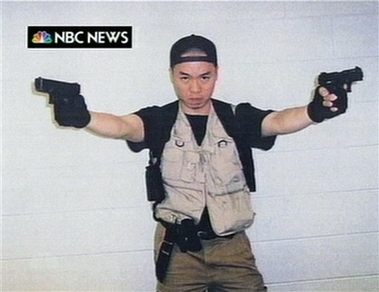
  5. Cho Seung-Hui, the VA Tech shooter, looking altogether sane as he calmly describes his rationale for killing random strangers: “I’m getting back at rich fucks” (paraphrase).

    In 1991, 35 year old George Hennard crashes his pickup truck  through a wall, shoots and kills 23 people, and then shoots himself.

  6. In 1999, in Colombine, two students kill 13 and wound 23 others before killing themselves.
  7. In 2007, 23 year old Seung-Hui Cho kills 32 people and wounds many others.  Before killing himself, he sent in a tape laced with profanity citing the need for revenge on the wealthy.
  8. In 2009, 28 year old Michael McLendon shoots 10 people, including his mother, grandparents, aunt and uncle, and then himself.
  9. In 2009, a man named Wong shoots 13 people at an immigrant community center, and then kills himself.
  10. In 2009, at Ft. Hood, Nidal Hasan, age 39, kills 13 people and shoots 32 others.  (Source is CNN)
So, how can we still be shocked?  How can the guy who sells tactical gear over the internet be shocked?  How can Bass Pro be shocked?  How can I be shocked?  But I am.  It is shocking how shocked America is.  Shootings like these have been happening for a long time and will keep happening as long as people become mentally ill and have access to guns.  If they had access to can openers, they would use that.  If they had access to nuclear warheads, they would use that.  Frankly, I am surprised it does not happen more, considering US rates of suicide and depression.
So, what is the solution?  Maybe we should ban guns entirely.  Maybe.  Or maybe we start with just asking some more questions when someone buys an AR-15 with a 100-round magazine.  That is, of course, if it is not too inconvenient.
I’m with Bloomberg.  I want to hear Romney and Obama talk about their position on gun control.

Money is Power—Since Last Week Maybe

So in addition to strategic planning with Habitat, and relaxing, this summer I have been drafting a manuscript on just-war theory and pacifism.  As part of that project, I am conducting a survey of about 150 major wars and conflicts throughout recorded history.  I want to get some sense of what actually causes wars and when they might be justified.  I have finished 40 so far and it is, in a word, fascinating.

I discovered the An Lushan Rebellion of 755-763 in China, where potentially 15% of the worldwide population was wiped out.   I also discovered that Afghanistan was a very peaceful and stable monarchy from 1933-1973 that was progressively modernizing.  Trouble started when a progressive king pushed democratic reforms, which led to communists finding their way into the government, which led to a backlash, which led to a communist coup, which led to a soviet invasion, and the rest is history.

I will post more random observations that may or may not find their way into the manuscript, but I wanted to share one right now that likely will not: it is interesting how in earlier epochs of history military power was surprisingly unconnected to money and economic power.  In an earlier time, though still unlikely, the little guy could really take on the big guy and win.  Today, economic might is tied directly to military might, and the rich country is, almost automatically, the more powerful. Obviously, the country that can produce more tanks, guns, aircraft, ammunition, food, etc., should generally win.  However, before the industrial revolution, a bigger economy did not guarantee your safety and better military technology was not automatically had through vibrant industry.  Consider these examples:

  1. Ancient greece before Pericles or the Aetolian League was, compared to it’s neighbors Egypt and Persia for example, a cultural backwater of poor sots, of city-states trying to scratch out a living on relatively infertile lands and a comparatively fish-less sea.  Egypt was already a well-established and wealthy civilization.  When the Athenians and Spartans fought the Persians, it was roughly equivalent to America fighting Honduras, and Honduras winning.  The greeks might not have had much money, or commerce, or industry, but they had the phalanx, and that was enough to defend themselves against the mighty Persian empire.
  2. Even within the Greeks, Sparta was the dominant power in Greece, and beat the Athenians at the height of Athenian power.  But they were famously poor.  Please enjoy the following quote from Thucydides that I love dearly (I neglected to include this when I first published this post).  It comes at the beginning of his brilliant account of the Peloponnesian War. It seems to me incredibly far-sighted. The man had a proper sense of history, and makes a clear point: wealth does not equal power.”Suppose the city of Sparta to be deserted, and nothing left but the temples and the ground-plan, distant ages would be very unwilling to believe that the power of the Lacedaemonians was at all equal to their fame. And yet they own two-fifths of the Peloponnesus, and are acknowledged leaders of the whole, as well as of numerous allies in the rest of Hellas. But their city is not built continuously, and has no splendid temples or other edifices; it rather resembles a group of villages like the ancient towns of Hellas, and would therefore make a poor show. Whereas, if the same fate befell the Athenians, the ruins of Athens would strike the eye, and we should infer their power to have been twice as great as it really is. We ought not then to be unduly skeptical. The greatness of cities should be estimated by their real power and not by appearances.”  Source.   Emphasis added.
  3. Alexander the Great, a Macedonian, conquered the persians, and the Egyptians, and the Greeks, and others too.  He did not have much more money.  Instead, he had a phalanx too, but one in which they got rid of their shields so they could hold longer spears.
  4. Rome, that pantheon of wealth and economic power, fell prey to relatively poor barbarian hordes.
  5. The mongols were poor nomadic peoples whose hordes conquered the wealthy Chinese civilization, the wealthy Persians, and many others.  Those steppe peoples had excellent cavalry, but very little money or economic power.
  6. The nomadic Arabs conquered Spain, North Africa, Egypt, Persia, the Byzantines, etc., and they also did not have incredible economic might.
  7. The English under queen Elizabeth went up against the mighty Spanish, who were far superior in money and arms, and yet were still defeated.

The list goes on…

It is hard to imagine this world because it is so different from our own.  Our basic understanding of geopolitics is thwarted.  Imagine if the richest countries in the world fearing invasion by poor neighbors who might covet foreign wealth.  This is a world where the United States would fear an invasion by Haiti, and where starving Haitians figure they might try their hand at an invasion, since, after all, it might succeed.

In theory, I like the old world.  I like the romance of powerful peasant countries.  But perhaps, in our new world order, war will become increasingly unlikely because a poor country can’t just invade a rich country because they covet foreign wealth.  But it also means that the rich will get richer, and their wealth will be unavailable to the poor, even if they are incredible soldiers led by Alexander the Great himself.

But maybe I am wrong.  But what about Vietnam?   What about Afghanistan?  Aren’t these modern examples of the little economy beating the big economy?  Perhaps, or perhaps these are exceptions that prove the rule, or perhaps victory of the little guy over the big guy is still possible—at least when the little guy’s military equipment is being shipped in from rival big guys’.


From Alicia, With Cardamom

I am commandeering Jeremy’s blog today for a truly noble and upright purpose:

Sri Lankan Rice Pudding

Why rice pudding, you ask?  Well, when all you eat is rice every day for every meal, you will get around to it eventually.  By Sri Lankan, I in no way claim to know anything about making actual, traditional Sri Lankan food.  But trying to make rice pudding in Sri Lanka requires a fair bit of thinking around the typical lemon zest, cinnamon, nutmeg, and heavy cream routine.  Instead, all the ingredients are very local.  The result: best damn rice pudding I’ve ever tasted.  Enjoy.

Ingredients

3/4 cup rice (cup measurements are eyeballed using a drinking glass…)

4 cups milk

2-3 eggs (some recipes call for only yolks, in which case you’ll need more)

Some vanilla extract (no measuring spoons on hand…)

1-2 cups sugar/honey/kitul syrup (depending on your sweet tooth)

Zest of one lime (little, like a key lime)

Some whole cloves

Some whole cardamom pods

1 400ml (~14oz) can of heavy coconut milk (is there any other kind??  Actually, here they use it so much they have “light” coconut milk too 😀 )

1/2 cup sultanas/raisins (optional)

Directions

Mix the milk, rice, cardamom, cloves, and lime zest.  Bake for 30 minutes at 350 degrees (I’m working on a celsius oven, so, you know, take the times and heat with a grain of salt… or sugar).  Take out of the oven.  Mix up the eggs and add them, coconut milk, sweetener, vanilla extract, and raisins, if using, to the dish.  Bake 30 minutes at 350 degrees, take it out and stir it a bit, so the rice doesn’t fall to the bottom of the custard. You should also take out the chunky spices at this time.  Bake 30 more minutes at 350 or until it’s the consistency you would like and/or has a nice, golden skin.


Adams vs. Jefferson Repeat in 2012

In 1800, John Adams was accused of being an out of touch, arrogant, elitist while his opponent, Jefferson, won with the image of a real American, a man of the people, and a champion of liberty.  For example, in a well-publicized national discussion, when the new republic was trying to decide what to call the president, Jefferson pushed for the title “Mr. President” while John Adams was willing to call him “His Excellency” or something that lent the position more gravitas.  Adams, spending years abroad in England and France, was viewed as having been poisoned by aristocratic and foreign sensibilities and communism was to Joe McCarthy’s USA as monarchy was to Jefferson’s.  As part of the Federalist Party, albeit a reluctant member, Adams wanted to consolidate government power while Jefferson, of the people, by the people, and for the people, had spent his whole life in America and was the people’s man.  He wanted their freedom and saw the small-holding farmer, as opposed to industry, as central to American life.

But biography is ironic.  Jefferson was the son of a rich plantation owner.  At age 21, he inherited 5,000 acres (20 km2) of land, 52 slaves, livestock, his father’s notable library, and a gristmill.  In 1768, he used his slaves to construct a neoclassical mansion known as Monticello.  In 1773, the year after Jefferson married a young widow, her father died. She and Jefferson inherited his estate, including 11,000 acres and 135 slaves.  With these additional slaves, Jefferson became the second largest slaveholder in Albermarle County with one of the biggest estates. The number of slaves from this time forward would fluctuate around 200.

Jefferson enjoyed an enormous income for his entire life, yet was almost always deeply in debt.  He spent lavishly and was constantly remodeling Monticello for no particular or practical purpose.  He spent great sums of money while abroad, especially in France, where he enjoyed the French aristocracy and their way of life.  He loved fine wine, expensive furnishings, and speculation, and died 1-2 million in debt.

Adams, on the other hand, was raised by a farmer who farmed the land himself.  Young Adams loved farming and he ran a farm his entire life, which he worked whenever possible, shoveling manure and plowing fields without the aid of slaves.  (Adams thought the only sensible investment was in land.)  As a boston lawyer, he had trouble making ends meet, and had to farm.  He hated taking cases without merit.  In fact, he took the case defending the British soldiers at the Boston Massacre, the case that launched his public career, in part because he was having trouble finding work.

Throughout his public career, Adams was frugal with his modest income, especially while serving abroad in the company of high socieity, which, unlike Jefferson and Benjamin Franklin, he hated.  He could not stand the theatrics, the sleaziness, the politics, the make-up, the decadence, or the rich food; it disgusted him and he never fit in.  In fact, Franklin had the Continental Congress recall Adams against his will because he was too blunt and impolite; he was a “bull in a china cabinet.”

Nonetheless, for decades, no matter what he did, Adams could not shake the public image of an elitist snob who had been poisoned by foreigners, and Jefferson won the 1800 election.

Barack Obama has also been called an out of touch, arrogant elitist.  I hear it daily.  Indeed, he has given some fodder for this charge.  During his 2008 campaign, he mentioned that rural Americans can “cling to guns or religion or antipathy to people who aren’t like them or anti-immigrant sentiment or anti-trade sentiment as a way to explain their frustrations.”  He called the economy “fine” a few weeks ago.  He spent some parts of his life in foreign countries.  Maybe he is out of touch with real America?

But Obama, we must remember, was raised by a single mom who worked for non-profits.  Mitt Romney’s dad, George Romney, was a successful businessman, a multi-millionaire, Governor of Michigan, Sec. of HUD, and ran for President against Nixon.

Obama finished paying off his school debt in 2004 and, though he is a millionaire now, only became one from book sales after his 2008 campaign picked up.  Romney, on the other hand, is worth over $250 million, making him the richest man ever to run for president — he always has been the 1%.

Obama was a community organizer working closely with underserved populations in Chicago before he became a lawyer, professor, state senator, Senator, and then President.  Mitt Romney worked as a Mormon missionary in France, a high-powered business consultant, a wildly successful venture capitalist executive for 14 years with an initial $37 million, chaired the 2002 Winter Olympics, became governor of Massachusetts from 2003-2007, and has been running for President ever since.

Ultimately, I’m not sure what “out of touch” is supposed to mean.  Everyone is “in touch” with something.  As for me, I like Obama because he, like me, is multi-cultural and has been exposed to poverty.  Like me, he knows what it is like to worry about school debt and making ends meet since the majority of his life he paid close attention to electricity bills, travel expenses, and food prices.  He understands why they are important.  Romney seems like a good guy, but he has been enormously wealthy nearly his entire life.  Romney is Wall Street to Obama’s Main Street.

Did you hear about the $12 million expansion to his Ocean Front property in San Diego?  It includes a car elevator.  But car elevators can be super cool right?  Romney could be just a rich guy having everyman fun, like Obama when he enjoys the perks of bringing the musicians he loves to perform in the White house, or flying up to NYC for a dinner and a show with Michelle.  But surely all excess does not signal everyday humanity.  Maybe some excess is just excessive, such as the time and ink spent on this whole discussion of who is more ‘out of touch.’

So, vote for Obama?  It’s not really my point.  Instead, let’s just all try mightily not be as out of touch as the electorate in 1800.


Sri Lankan Adventures: Trincomalee

This slideshow requires JavaScript.

Alicia got to Sri Lanka last weekend.  We were together for two days, and then she took a trip to the field while I stayed in Colombo for a bit.  We met up in Trincomalee, but only after I took an 8 hour night train.

Eventually my train pulled in, and after rushing around frantically, I was shown by a beetle-nut red-mouthed man my first class cabin. The description said that it would be air-conditioned.  This was a lie from the pit of hell, which makes sense I suppose when tickets for such a long train ride are only $6.  There were two bunks, with a shared bathroom (see the door on the right in pictures), with a hole for a toilet through which I could see the railroad ties.  Fortunately I did not have to share the room, but as I laid down a massive cockroach (they come in sizes) scuttled down the wall and over my pillow.  I tore off my sandal to kill it but it was too late, so, after staring out the window for a bit, I laid down on the oily sheets and tried to sleep with my roomate.

I woke up with calls for Trincomalee at 6:10AM.  Meandeared over to my hotel, and slept for a few hours before my wife joined me.  That day we went to the local fort, which has changed hands between the Dutch, Portuguese, British, and French maybe a dozen times.  Admiral Nelson called the Trincomalee harbor the best natural harbor in the world.  We also went to a hindu Temple.

We then took a walk along the beach, which as beautiful, but growling slum dogs kept popping out from behind beached fishing boats to push us into the ocean, where there were millions of sharp fishing bones in the sand, especially vertebrae that seemed like tiny invisible sea urchins, and they got into our sandals—a strangely stressful experience, but an interesting one.   These slums were right next to beach resorts.

We then made friends with a local man who could explain to us what foods were good to eat, I swam to a rock outcropping, and it was beautiful.  But those pictures are on another camera.

The next day, we went up North to Nilavelli, Sir Lanka’s most famous beach and was often visited before the war.  Now it is starting to come back.  After eating lunch on the beach, we took a trip over to Pigeon Island, which as beautiful and

Alicia and I on Pigeon Island

has, we are told, some of the best snorkelling in Sri Lanka.  It was Alicia’s first time snorkeling and it was a success.  We saw corals, sea urchins, dozens of different types of fish, but probably the highlight was the sharks.  We saw several blacktip sharks, one just over a meter long, that came right at us before veering off at the last second.  I was clutching Alicia so she would keep me safe!

Afterwards we took a bus home for $3.60 each.  It came up as I was buying some local treat, and the folks outside yelled at us “Colombo!  Come!  Colombo! Come!”  We jumped on board and were crammed together for 8 hours, perhaps 2 of which Alicia had a man leaning over her with his crotch more or less in her face, but besides that it was fairly good, though we were glad we brought ear plugs.  They like their Sri Lankan jams!

Now we are back in Colombo.

BTW, thanks for all the feedback all over facebook on my civil war post.  It has been very interesting reading.


I Was Wrong…

…the American Civil War was not about states’ rights, but about the South’s desire to keep slaves.

As you may be aware, I take a bit of pride in my knowledge of U.S. history, especially in knowing more than most ‘real’ Americans.  Getting a perfect score on my AP US History exam in high school, and my Mother teaching me thirty or so American songs like the Caisson Song, Goober Peas, and all 6 verses of When Johnny Comes Marching Home Again, guaranteed me deep insight and a place in respectable society.

Seriously, before a week ago I thought that the Civil War is more aptly called the War of Northern Aggression and that, instead of slavery, it was really about states’ rights.  My Uncle, a retired Virginia State trooper, explains that throughout our history, the United States has generally encouraged the liberation of peoples rebelling in favor of self-rule, but only when they rebel in other countries.  Good point.  And, after all, as my friends and old neighbors in Atlanta, Georgia might point out, the South did not invade the North; they would have been happy to leave the North alone.  The North were invaders and then occupiers.  They could not stomach peaceful secession.

Also, I thought that slavery, rather than being the reason for war, was merely the catalyst for it; it could have been any number of other issues that would have challenged the Constitution’s lack of clarity on whether or not a state was allowed to secede from the Union.  The incidental issue of abolition, though morally upright, happened to be what the North was trying to ram down southern throats.

So I have held my nose up at those simple-minded people who read today’s morality into the motivation of the North—who don’t really know history.  Most Unionists were as racist as most Southerners, and still are.  Yet, while I still think there is good reason to call the Civil War “the War of Northern Aggression,” I no longer think the war was really about states’ rights for three reasons.

First, in the compromise of 1850, the North sought and passed a provision guaranteeing that the North would help return slaves discovered in its territories.  This amounted to free states, that had passed laws banning slavery, who thought slavery was wrong, being forced to abide by the rules of another State that they strongly disagreed with.

(This also had the effect of generating a backlash of anti-slavery sentiment among Northerners who, though racist and quite willing to allow the institution of slavery to exist if out of sight, were not comfortable with the immorality that was being paraded in front of them.  I see striking similarities to the spread of pro-LGBT laws in America, which could cause a backlash if imposed on populations not yet ready it.)

Secondly, the South was unwilling to allow new states to decide for themselves, when entering the Union, whether they would be slave or free.  Because of the even balance of power in the Senate, slave states pushed the United States to mandate some territories to become slave states, even if they did not necessarily want to be.  At the time, the South argued that this did not violate states’ rights because a territory is not yet a state, but that is misguided for two reasons.  First, after a territory becomes a state, it would then need to acquire the rights of a state, which should include the power to decide whether it wants to change to a slave or free state.  Secondly, at the core of the ideology of states’ rights is the principle of self-rule—it should not matter if the area is a territory or a state, they still should have the right to self-determination.  This was violated in many ways.

In the Missouri Compromise, all land below the 36°30’ parallel (southern border of Missouri) was guaranteed to become slave states.  Because of this, efforts were made to annex foreign land and make them slave states.  Unsuccessful plans included annexing Cuba & Nicaragua.  Successful plans include the Mexican War, which was fought in large part by James K. Polk as a land-grab, not just for the United States, but for the slave-holding South.  Finally, the South wanted Kansas, when it joined the Union, to become a slave state, though in main its people did not want slavery.  Eventually it would become a free-state, but only after wrangling in Congress, bloodshed (150 killed or injured), and a raft of Missourians coming over the state line to vote illegally for pro-slavery constitutions.  Of course, this also broke the South’s compromise with the North: Kansas was above the 36° 30’ parallel.

What drives this point home for me, that the South was not really interested in States’ Rights, is that the Democrats, the only truly national political party at the time, with deep roots in the South and pro-slavery policies, tried desperately to hold together a national coalition by appealing to self-determinination: a middle ground which guaranteed the rights of states and territories to decide for themselves.  Stephen A. Douglas, the Democratic nominee in 1860, was fighting for states’ rights.  But the South would not have it.  So, while 14 out of 15 slave states had voted Democrat in 1856, Douglas only got one in 1860.  Instead, Southerners opted for John C. Breckenridge, a pro-slavery candidate, who won 11 out of 15 slave states.  But Lincoln swept the North and became president.

The final reason why the Civil War was not really about states’ rights has to do with the South’s reaction to Lincoln’s victory.  What must be understood is that, since George Washington, only moderate and pro-slavery presidents had been elected. In fact, of the 15 presidents before Lincoln, five did not own slaves and 10 did, most of them Virginians and southerners.  Of those 10, eight owned slaves while they served as president.  Of the five who never owned slaves, two were John Adams, a practical moderate, and his son, John Quincy, who was powerless.  The other three directly preceded Lincoln: Buchanan (Dem), Fillmore (Dem), and Pierce (Whig).  They were picked in large part because of their acceptance of slavery.  (Source cited by factcheck.org is here.)

In other words, for years, abolitionists had been losing elections and accepting them anyway.  This, after all, is the essence of democracy.  But, when the abolitionists had won, the South could not accept the outcome.  They did not wait for their cherished states’ rights to actually get trampled on.  Seven states seceded before Lincoln even took office.

Ironically, Lincoln was a clear-eyed pragmatist who would have probably been quite reasonable and measured in his policies.  His Emancipation Proclamation is rightly understood as a war measure, meant to weaken the economy of states that were in rebellion, and to muzzle any possibility of France or England, both having already abolished slavery, coming to the aid of the confederacy.  Also, the Proclamation did not free slaves in Tennessee, Kentucky, Missouri, Maryland, and Delaware, and specifically excluded numerous counties in some other states.  Lincoln did this so as to not push border states to join the Confederate cause.  As a result, some of these states did not ban slavery until they ratified the 13th amendment over three years later—6 months after the war was over.  This points to the likelihood that while Abraham would have certainly applied pressure with an aim to end slavery, he was not prone towards ideological or drastic measures.  But the south took their marbles and went home, before their states’ rights were even infringed on, but after it was clear that their power in the federal government to protect the institution of slavery was waning.

After listening to about 30 lectures detailing the first 80 years of American History (6 part Heritage Series), it is difficult for me to see this era as being dominated by a burgeoning crisis of states’ rights—of the majority of states forcing their will on the few.  Rather, we are witnessing, primarily in the South, increased racism, increased dependence on slavery, and increased fear that necessitated the preservation of their power so that they could continue and spread the institution of slavery.

But of course, “the American Civil War was about the South’s desire to keep slaves” is a sweeping historical statement.  There were many other factors involved, economic and otherwise.  In the end, it is probably only mostly true—I’d say about three fifths.


My Wife is a Master of…

…Development Practice.  Hell yeah!  Emory University says so, “the Harvard of the South.”   She graduated a few weeks ago and I neglected to post about it.  At first it was raining, and there were about 3,000 people in suits and dresses frowning and upset out on the quad, straining to see what was going on, and getting wet.  It made me happy.  I love weather!  But then the sun came up and everyone was happy.   Us too.

I am very proud of her.

Also, before I left the States some classmates and friends rafted 5 miles on Class III and IV rapids on the Ocoee River, the same river that was used for the slalom kayack races for the 1996 summer Olympics. Cool!  It was my first time to raft so they let me ride up front.  It was quite possibly the best thing ever.

I do apologize for all these obnoxiously personal posts.  Very soon I will get back to my intellectual adventures.  There is much to discuss!


Sri Lankan Church Bulletin Quotes Teddy Roosevelt

Today I went to the Grace Evangelical Church here in Wellewatte, a southern suburb of Colombo, Sri Lanka, and ran across a quote by Theodore Roosevelt that was printed in the bulletin.

“It is not the critic who counts, nor the man who points out how the strong man stumbled or where the doer of deeds could have done them better.  The credit belongs to the man who is actually in the arena, whose face is marred with dust and sweat and blood…and who…if he fails, at least fails while daring greatly, so that his place shall never be with those cold and timid souls who know neither victory nor defeat.”

Right now I am meandering through a colossal audio series of 90 lectures on American history, and I am eager to get to Roosevelt.  The man was uber egotistical, great, and terrible, but besides the elitist desire exhibited in this quote to be set apart from lesser, more timid souls, I think he is right on the money.  I had a hard time paying attention to the sermon cause I was thinking about Teddy and failure.

More and more, I have come to feel comfort in failure because it is a sign that I am in the game.  Of course, we should never love failing, but we can take pride in it.  There is great dignity in having your business fail, a lover leave you, or receiving rejections from potential employers or schools.  All one can ever do is give it their best shot, and God and luck do the rest.  Instead, honor dies when our energy wans—when we remove ourselves from the “arena” of judgement so that we can pretend ourselves to be immeasurable.

Mostly unrelated to that: I find it interesting that so many great American politicians were never presidents, and were often more powerful figures than their contemporary presidents, and yet considered themselves to be failures because they did not become presidents: Alexander Hamilton, Henry Clay, John C. Calhoun, Daniel Webster, Stephen A. Douglass…ok, I’m only to the 1860s.  I was trying to think of great politicians in modern times who did not become presidents, and I could not, at least not anyone of the stature of these men.  Any ideas?


Comfortable Estrangement on my Birthday

I have not lived in a very foreign country since I left Taiwan nine years ago (England doesn’t count as “very foreign”).  But walking down the street yesterday in Dehiwala, Sri Lanka I felt that I was home.  I did not fit in, I was white, I was wearing weird clothes, and I walked down the street completely chillax as people stared at me a little more than normal.  Here I ask stupid questions.  I constantly try new things.  I do not know what I am doing.  This was my life for years, and, after 9 years, the rediscovered feeling of estrangement was comforting.

In America, nobody stares at me, at least not usually.  I usually know what is going on, but not as much as people think.  I don’t like asking dumb questions.  I don’t stick out, even though I sometimes feel like I do.  Here, even though Sri Lanka is very different than Taiwan, I feel the way that I look: I am a foreigner.  There is no pretending.

So I felt very much at peace yesterday, even though it was my birthday, and nobody knew it within about 1,000 miles, my wife was in Houston, Texas, scared she might not make it to Sri Lanka this summer, and we are both worried about how to pay for grad school, finding jobs, getting my book published, and I am sad that Elinor Ostrom died that morning.  (My online community was very lavish in birthday affection though.  Thanks!)

In my newfound comfort, I enjoyed going to Viharamahadevi Park (formerly Victoria Park).  It is a public park next to the National Museum in Sri Lanka. It is the oldest and largest park in Colombo and situated in front of the colonial-style Town Hall building.  A caretaker gave me an impromptu tour.  He then asked for money, and I gave him less than a dollar.  He was not pleased with me : )

This slideshow requires JavaScript.

I also had some videos, but apparently I have to upgrade my wordpress account to post those :  (


Sex in Sri Lanka

According to local sources, extra-marital affairs, and PDA, is acceptable in Colombo, but not the rest of the country.  Homosexuality is not acceptable anywhere, though there are plenty of secret gays–at least that is what Anuhas tells me.  I thanked him for this information on behalf of my blog readers.

Unrelated to that, here’s some pics from a trip downtown the other day.