Personal Post: Studies, a Job, and Moving to DC

Since I posted two weeks ago…

…I flew back to Atlanta from Sri Lanka, slept in a hotel, then flew to Philly where I spent the week staying at my Aunt and Uncles’ while experiencing one of the most engaging intellectual experiences of my life at the University of Pennsylvania.  It’s a bit hard to convey.  In short, I feel alive in a way that I have not been for five years—since college really.  I am such a nerd at heart.

I flew back to Atlanta, met up with Alicia who just flew in, and she got a job offer!  After negotiating with HR, we are now moving to DC.  Alicia and I drive up tomorrow, hitting up some friends along the way, and will get there Sunday.  We’ll apartment hunt and then I’ll fly down, get our stuff with my Dad’s help, and bring it on up and set up the place.  Meanwhile, I am trying to keep up with a full academic load.

In other news, if you haven’t already, check out Bill Clinton’s speech at the Democratic convention.  It was entertaining and enlightening—exactly my philosophy of communication.


Flat Tax is Progressive and Insufficient

Obviously, a flat tax based on a percentage of income is already a progressive tax.  Assuming a 10% flat tax, the Trumps making 30 million a year are paying 1,000 times the amount in taxes as the Browns making $30,000.  However, this is still insufficiently progressive and makes me think about a passage from the Bible.

38 As he taught, Jesus said, “Watch out for the teachers of the law. They like to walk around in flowing robes and be greeted with respect in the marketplaces, 39 and have the most important seats in the synagogues and the places of honor at banquets. 40 They devour widows’ houses (emphasis added) and for a show make lengthy prayers. These men will be punished most severely.”

41 Jesus sat down opposite the place where the offerings were put and watched the crowd putting their money into the temple treasury. Many rich people threw in large amounts. 42 But a poor widow came and put in two very small copper coins, worth only a few cents.

43 Calling his disciples to him, Jesus said, “Truly I tell you, this poor widow has put more into the treasury than all the others.44 They all gave out of their wealth; but she, out of her poverty, put in everything—all she had to live on.” (Mark 12:38-44, NIV)

What I take from this example is that the cent we might tax from the widow is worth more to her than $1,000 from the Browns, which is worth more to them than $10 million from the Trumps.   If we tax the widow, she starves.  If we tax the Browns making $30,000 a year very much at all, it makes it entirely likely that the daughter cannot take piano lessons, the son cannot go to college, they cannot afford to have a vacation that year, and perhaps the father cannot start a business.  For the Trumps at $30 million a year, even taxing them at a rate of %90 would not threaten their ability enjoy any of these opportunities, and they certainly would not starve.  They would still have $3 million a year; dad can start a business, son can attend the ivy league, and the daughter can take lessons from Vladimir Ashkenazy if they want.

I am also reminded of this dynamic as I live in Sri Lanka.  For example, a typical taxi fare in a Tuk Tuk is 50 rupees per kilometer, which is the same as $0.62 per mile.  A 15 minute trip can cost $1 and people can haggle for 10 minutes over 25 cents.  Clearly, not all 25 cents are equal.  It depends on where it comes from.

In the Great Leap Forward, Mao Tse Tung quite famously required his people to fill quotas for mining iron, with the result that many peasants simply had to bring in their pots, pans, and plows to be melted down.  Obviously, this is an extreme example, but the point remains: if our tax policy and economic system threatens the Browns’ opportunity for education, advancement, of building up savings, of pursuing dreams, we will certainly have more iron ore, but at great expense.

The deficit does not care who pays it—a dollar from the Browns is no better than from the Trumps.  Perhaps we should consider, among other important considerations, using the least costly money whenever possible.


Mr. Darcy & American Aristocracy

So apparently Romney pays around 13% a year in taxes on an income of over 20 million dollars.  Paul Ryan paid 20% on $323,000 in 2011.  And many of the most wealthy people in the United States, billionaires even, are paying less than 10% (CNN).

This is because wealthy individuals gain most of their income through return on investments, quite often in the form of capital gains which is taxed at a lower rate.  This is because not all real income is real income.  Some of it cannot be spent on whatever the new owner of fake income wants to buy.  And much of it cannot be deposited in a savings account because it can spontaneously combust.

Lately I have had a strong sense that I live in an immoral society—tt assails me like a stiff wind—not because everything about America is awful, indeed I love my country, but because we are thoroughly corrupt in at least this respect: as a society we have decided to favor, and to create, an upper-class.

Until quite recently, the English aristocracy was alive and well, and dominated English society.  I love Victorian movies and books (I’m still a hardass though!) and recently my curiosity was piqued by the constant discussion of income, “Mr. Darcy has 20,000 pounds a year!”  Do they mean wages, capital gains, or what?

I looked into it, and it turns out that to be an English aristocrat you usually had to make over $3 mil. a year (adjusted for inflation).  They did not acquire this income through business ventures, mercantilism, wages, or through any great talent on their part really.  It came from speculation, investments (most often chosen by others), and rents from large estates and tracts of land — it came from pre-owned wealth.   The Duke of Marlborough, one of the richest aristocrats of the time, pulled in $52.5 mil annually.  To put that in perspective, Warren Buffet pulled in $62 mil. last year, also from pre-owned wealth (admittedly cleverly invested wealth, likely more cleverly I imagine than the Duke of Marlborough).

But Victorians considered the Duke’s income as real income while we pretend it is not, at least not as real as income made from wages.  Indeed, wages, the money received based on time, skill, expertise, and effort, should be taxed heavily.  That stuff simply should not be incentivized.  Don’t these people know they should already have wealth to invest?  Rather, aristocrats sitting on pots of gold and passing it down to their children…that is the stuff civilizational dreams are made of.

So if you love this American economy
Than vote for Mitt Romney
And I won’t forget the men who died
So I could make money,
And I’ll gladly stand up
For freedom
To speculate at low tax rates
Cause their ain’t no doubt I love this land
God bless the USA

(Based on the chorus of Proud to be An American)


My Life is Good for You

Next year I am going to be studying at the University of Pennsylvania in an episode of “Missionary Kid Meets Ivy League.”  I am very excited about it for many reasons, not least of which is the topic itself: positive psychology.

You probably have never heard of it.  That’s fine.  Positive psychology is a very new field which was started by Dr. Martin Seligman when he was President of the American Psychological Association in the early 90s.  He is widely seen as the father of the movement, but there are a number of other significant figures.  The Masters of Applied Positive Psychology program (MAPP program) that I am in is the brainchild of Seligman.  Throughout the curriculum he brings in other leading positive psychologists from around the country.  Students come from everywhere, from all disciplines, and so there is great cross-discplinary discussion of application and theory.  Also, most of the students are already well into their professional careers.  At 27, I expect to be on the younger side (and possibly the poorer side too).  Finally, the books I am reading in preparation for my studies are already changing my life and making me happier.  This is because positive psychology is fun to learn about—and it’s powerful shit.

I have heard it explained in many ways, but I think this is best: positive psychology is the  neglected half of psychology.  Since psychology’s inception with Freud, psychology has been mostly about psychosis—how to get mentally sick people tolerably functional and how to identify disease and understand how and why it arises.  In truth, I suppose you could call conventional psychology “negative psychology,” because it focuses on the negative aspects of mental health.  In contrast, positive psychology is the study of how to make mentally sick people, as well as normal, even high-functioning people, thrive and acheive optimal well-being, contentment, and meaning.  Additionally, it aims to identify the symptoms of strengths and look at how and why they arise, and how they can be built on and expanded.  Strengths might include resilience (the art of bouncing back), patience (why some people are more patient than others), positivity, gratefulness, etc.

You might say positive psychology is trying to put some science in the world of self-help books, or more accurately the vast world of self-help books is a response to a felt need that academia has, until recently, been neglecting.  Not anymore.  Positive psychologists are making progress and getting loads of funding for lots of studies.  More and more, there are emerging simple strategies and exercises one can use to bolster and maintain high-levels of well-being.  These strategies have been tested scientifically, with double-blinds, placebo-controlled groups, and all the rest.

Science is finally looking at joy and it is about damn time.  I think it is quickly going to become a very very big deal globally.

Today, if I came up to you and said, “Holy nut buckets, I hate this toothache!  I seem to have cavities all the time now,” you might ask me if I brushed my teeth regularly.  If I said “no,” you would rightfully ostracize me a bit.

Brushing your teeth is an intervention that we have all come to accept as part of our routines and completely necessary for staving off important problems.  Similarly, I predict that some interventions that positive psychology is identifying will someday become as normal for society as brushing our teeth.  If someone is depressed, but is not “brushing their teeth” as positive psychologists would have us do, then rightly or wrongly it just won’t be culturally acceptable.

Over the next year, I will be describing some of those strategies and interventions.  Perhaps even more interesting to me, I will be struggling with enormous ethical, political, economic, philosophical, and even theological implications of positive psychology.  What is happiness?  What is the role of the church when science has a more reliable record of pointing people towards well-being?  What happens when rich people, who previously have not been much happier despite their wealth, now have access to education which can make them happier?  How do we apply positive psychology to my work in economic development and strategic planning?  What does positive psychology mean for inner-city streets and community organizing?

As I ask these questions, I hope to post about them, and maybe you can help me sort them out and benefit from what I am learning too.  I think you will find that my life is good for you.   I know it will be good for me.

This is going to be a great year!


Courageous Ryan Pick Mystifies Me

Does the Ryan pick make Romney a political Jedi Master?

I have combed through dozens of articles, by conservatives and liberals, but I cannot get away from this fact: Ryan was known only for his ‘Ryan Budget.’  Without it he is just 1 of 435 House members.  And I do not know why Romney wants to make the Ryan Plan central to his campaign.  Regardless of whether you like it or not, the Ryan Plan is objectively quite unpopular.

I feel like only a couple of years ago, most everybody, Republican and Democrat, appreciated and respected Ryan, but saw him as politically toxic because of his entitlement reform plans.  In fact, he was never seen as having a chance at President or Vice President, or any greater ambition really.  His was an important voice that deserved applause but not an embrace.  While the Republican party might have changed recently, I do not see his views as any less offensive to moderates and independents.   Romney’s embrace of Ryan also reinforces the narrative that “rich Romney loves tax breaks for the rich” (the Ryan Plan calls for tax cuts for the wealthy paid for by spending cuts in entitlements that come into effect a decade or so later).

This choice also undercuts Romney’s talk about how governorship and business experience (executive experience) is what America needs right now.  As I argue in Boardwalk, Park Place, & Veepstakes, he should have put all his chips into one argument:  America, hire the uber-competent team of Mr. Fix-Its.   There was a degree of magic in a Pawlenty pick.  Though a bit boring, that would have been in fact a strength: it would have made the campaign about Obama’s record instead of an extremely unpopular budget proposal.  (And it looks like the Obama high command was very afraid of a Pawlenty pick too.  But Ryan is great to run against.)  In contrast, Paul Ryan has DC legislative experience only and has “never run anything”–not a business, city, or state–much like criticism someone else received  in 2008 (his name rhymes with Osama).

Maybe Romney picked Ryan to show that he is capable of making tough choices?  This choice certainly makes Romney appear substantive.  Ryan is bold, smart, and offers specific policies, but I’m not sure the substance is something they can win on.  However, this is the one of the best arguments I have read.  Romney needs to look like less of a sleazy hair-do.

Maybe Romney picked Ryan to get Wisconsin?  But Ryan has not campaigned statewide; most Wisconsonians have never heard of him.  And even if picking Ryan does get him Wisconsin, that is only 10 electoral votes.  Florida, with 29 electoral votes, is almost certainly lost because Ryan’s entitlement reforms don’t play well with older populations, and the Ryan pick will drag down the vote in older populations everywhere else in the country.  In contrast, picking Rubio would have helped Romney win Florida (Rubio was a Senator), and help with latino turnout in ever single state with latino populations, including important swing states like Nevada and New Mexico.

Maybe Romney did it to keep the focus on the economy and domestic policy, compared to foreign policy where Obama has a comparative advantage?  But that did not need to be done; the conversation was already going to be about the economy and domestic policy.

Maybe Romney did it because he wanted to leave the party with a legacy of thoughtful articulate conservatism?  He did not want to elevate a Sarah Palin.  Laudable, but I feel that Romney wants to win now.

But Romney is smart and savvy, s0 here I am waiting for the other shoe to drop.  Until then, this VP pick looks like courageous political suicide.  I am kind of impressed actually.

Romney, we hardly knew you. 


Boardwalk, Park Place, & Veepstakes

According to Politco’s swing state map, if the general election was held today, Obama would win a whopping 332 to 206 in the electoral college.  If somehow Obama loses all the states where he is currently winning by 4.5 or less points (Colorado, Iowa, Virginia, Florida, and New Hampshire) he would still win 271 to 267.  So I do not understand all the hubbub about Obama being super weak.

Of course, while everything can change, some changes are less likely than they might usually be.  For example, it is unlikely that some damaging piece of Obama’s bio comes out.  And though we cannot rule out a major disaster, those unite the country behind its president as often as not.  Also, a series of major gaffes by a typically disciplined Obama is not likely either.

So the economy, already a major factor no matter what, is likely the whole ball game, and we simply do not know what it will do.  Also, as I argued earlier in Political Jedi Master, the economy is the only leverage point with which anyone can beat Obama, and Romney, despite obvious flaws, is best suited to maximize that leverage.

So, with his back up against the electoral wall, what running mate should Romney pick?

I grew up playing monopoly and probably kept playing past the age when normal people stop.  One of the strategies adult-Jer learned seems relevant:

When it is down to the final two players, when you have hardly have any money left and your opponent has the majority of properties with plenty of houses and hotels, it is tempting to slowly sell houses evenly and keep enough money so that you can withstand a hit or two.  Of course, when it is neck and neck, this strategy makes sense: avoid unnecessary risks.  But, when your back is up against the wall, playing it safe will lead slowly, but inevitably, to defeat.  Instead, sell and mortgage everything, even if you do not immediately need to, except for Boardwalk and Park Place and put all your money into building hotels.  Even if you get lucky on your own rolls, if your opponent does not land on Boardwalk or Park Place, you will lose; if your opponent lands on them, but they are not super expensive, you will also lose.  The only way you win is if you get some luck and you were ready to capitalize on it by making Boardwalk and Park Place a mortal hit.

(I won using this strategy several times.  My brother would complain that it was dumb luck.  I would say it was luck…and clever cleverness.)

Romney’s Boardwalk and Park place is the economy; in order for him to win he has to get lucky (the economy has to decline) and he has capitalize on it when it does.  Rounding himself out by picking Condeleeza Rice for foreign policy, African Americans, and women, or Marco Rubio for the Latino vote, Florida, and a compelling biography, is like hedging his bets by keeping houses or hotels on other properties.  Instead, he needs to commit to the only winning strategy that exists for him: the economy is in decline and though he might not have an incredible personal story, snazzy oratorical skills, or middle-class roots, he is supremely competent.  He is Mr. Fix-it #1 and captain of the the Varsity Mr. Fix-it team.

For that reason, I think Romney should pick a former governor (executive experience) with a job creation record, a business record, and a Washington outsider, and they must have a persona of no frills, getting things done; they must exude competence like crazy.  I am thinking Tim Pawlenty or someone similar (Jon Huntsman cannot because “I’m a Mormon from Utah too!”).  I am sure there are other good names out there.  Maybe perusing through their bios and picking one will be another post.

Also, unlike Mccains pick of Palin, Romney needs to make a pick that reflects his main argument against Obama, “Obama is not uber-competent on the economy like me.”  (Mccain picked Palin under the banner, “Country First.”  No matter what you think of Palin, you have to admit that there were other candidates much more qualified to be President, and Mccain did not reinforce his case with his VP pick.)

So I am excited to see who Romney picks as VP.  Maybe it will make my list of brilliant political plays and Romney will prove himself  the ultimate political Jedi Master…or maybe he will not pass go and not collect 200.

Either way, I can’t wait!  This is history happening in front of our faces!

Incredible discussion going on regarding gun control.  I will post more on that soon.  Thanks for your comments!


My Gun Control Position Solidifies

We have another shooting: two days ago in Wisconsin a white neo-nazi named Wade Page killed 6 and critically wounded three, including a police officer who was shot 9 times.  Page used a legally purchased 9 mm handgun and had five pistol permits he got in North Carolina in 2008.  It sounds like he was a racist, but still fairly mild-mannered.  This sort of violence was not obvious from his background.

My thinking on gun control continues to evolve since I wrote Mass Murder’s Bright Future, in no small part thanks to the comments of some of my conservative friends.  I have never had a position on this issue, but my thinking seems to be leading me to somewhat solid ground.

First, guns have a unique psychological draw; they make you feel powerful and invincible, even sexy.  This draw affects the mentally unstable—and me.  As a kid, I certainly felt that way walking around my house with a nerf gun, or a cheap-plastic western-style revolver, randomly pulling it out and pointing it at things while striking dramatic poses.   If I were to go insane and felt like my life was careening out of control, I can imagine a scenario in which I might be attracted to that boyhood fancy.

Certainly a lot of combat troops in the USA all-volunteer army likes guns, and plenty of cops do as well, and that inclination played a role in many early career decisions (and almost did in my own).  I know my military friends would agree.  Perhaps this personal perspective is anecdotal, but perhaps insanity would result in less violence if gun violence specifically was not so damn attractive.

Second, I hate regulations that create black markets.  I personally experienced how bans on drugs and prostitution supported gangs, blight, and economic ruin in inner city USA.  In fact, I would go so far as saying we should legalize prostitution, allow sex-workers working rights, protections by the courts, a measure of workplace safety. etc.  We should tax it and pay for job training to transition them into other fields, etc.  (Alicia recently converted to this position!)  I also think most narcotics should be legal.  All this is to say, I am sensitive to the notion that banning can create a black markets and can be counterproductive.  However, banning guns seems different than drugs, prostitution or even alcohol.  Unlike prohibition, banning guns could work:

  • Alcohol is easily distilled, says all of my beer-making friends.  Prohibition proved that you cannot ban alcohol, because it is simply too easy to make.  Guns are not as easy to make.  But it’s harder to create make-shift guns: you can’t go to your local hardware store and easily assemble a gun. Sure it’s possible, but it’s harder, and that is a significant difference.  You aren’t going to supply a criminal underground with creatively conjured handmade guns.
  • It’s harder to manufacture illegal guns en masse as they are complex manufactured goods that require lots of parts from lots of places.  The parts of a pencil, for instance, are taken from all over the world.  Hundreds of companies are usually involved, while drugs require only one source and one preparation site.  Marijuana and other drugs can be grown/prepared in basements and whiskey stills are small and can be operated in a small hidden spaces.
  • Prostitution is simpler than drugs or alcohol; you just need another person and a few minutes.  Women throughout the country are willing to be paid for sex, and men, also ubiquitous it seems, are even more likely to be willing to pay for it.  I don’t think we are going to ban either gender soon, or separate them, in massive male or female only cities.  Also, what about same-sex prostitutes?  Banning guns certainly makes more sense than banning the exchange of currency for sexual pleasure.
  • Guns need to be resupplied; they need ammunition.  Even if people can get guns, we can make it increasingly difficult to get compatible ammunition.  While you would have to ban potatoes if you want to ban vodka, or corn if you want to ban whiskey, ammunition is not a basic food.
  • It’s harder to smuggle guns than drugs: guns cannot be shoved up your ass so you can carry them on a plane.
  • Finally, we all know gun bans work, right?  Countries around the world are already banning guns and quite effectively keeping them out of public hands.  Why not the US too?

Of course their are obstacles, but they all seem surmountable:

  • There are already tons of guns that are out there (400 million?).  We would have to find a way to get them back.  Maybe we could offer a period of a few months where the government would buy them back before they become illegal.  I’m sure there are better ideas out there…
  • We would have to amend the constitution.
  • We would have to, I believe, continue to allow hunting.  Maybe the government can encourage more bow hunting.  Maybe single shot rifles should be allowed.  After all, that was the firearm technology that the 2nd amendment was talking about.

So I guess I have to admit it: I think a comprehensive gun ban would be good.  I might allow single shot hunting rifles (any shot after the first are usually misses anyway), but I could be persuaded to lose them too.  Of course, cops and and military people would still need guns, and perhaps Alaskans in Zodiak country.

Maybe I’ll hear some good arguments and change my mind tomorrow.  Truthfully, even though my position has solidified, I still think this is a relatively unimportant issue compared to, for instance, the worldwide food sovereignty movement and prison reform. But still, there it is.

Note: I made up these lists off the top of my head.  It is complete fancy and could be misguided, but I find them interesting.  I mention this because a few times lately I have been accused of regurgitating democratic talking points.  I am fine being wrong, changing my mind based on argument, and laughing at jokes regarding my idiocy or large nose; I do that all the time.  But please know that my arguments and reflections are always mine.  I am honestly compelled or intrigued by them and would like your help making them better. The implication that I am unquestionably regurgitating lines from politicians is likely the quickest way to piss me off.  Anyone who knows me knows that I guard my intellectual independence jealously, perhaps even too much.  


Political Jedi Master: Bush Tax Cuts & Romney’s Returns

Politics is intellectual football.  Here are two recent and brilliant Obama plays.

#1 Extending the Bush Tax Cuts in 2010

I was pretty upset in 2010 when Obama let the Bush tax cuts be extended without much of a fight, but it was genius.  Not only did it coax a little more stimulus out of the Republicans for an insipid economy, money he could not have gotten for anything but tax cuts, but Obama timed the new expiry date for the extension perfectly.  Right before the 2012 election the Republicans were going to publicly position themselves against the middle class: “if we can’t cut taxes for the wealthy, than nobody gets a tax cut.”  And here we are!

Early on Obama’s team had to know, as all political operatives do, that re-election prospects would most likely be tied to how quickly the economy recovers, and how good the Republican candidate would likely be on economic issues and  related experience.  Even if the economy did poorly, an economy-deaf candidate like Mccain would likely mean an Obama victory.  If the economy did well, Obama’s broad like-ability would mean an Obama victory too.  Foreseeably, the only possible way that Obama could lose a 2nd term is if the economy continued to stagnate and an economic “can-do” Republican was nominated (I think this is why Herman Cain ran).  So, in 2009, what economic “can-do” guys were out for the Obama team to worry about?

In 2008, it was obvious to everyone Romney was that man and that he was going to run again.  In fact, I told people at back then, not because I am brilliant but because it was blindingly obvious, that Romney is likely the only Republican candidate who could seriously have a chance at beating Obama, because he could win on Obama’s only serious weak point.  Afghanistan was not likely to become a big enough problem.  ObamaCare riles Republicans, but not many others.  Pro-life or anti-gay issues?  No way.  That is a losing demographic battle.  Obama’s team was only worried about a Republican economic guru; and a guru happened to be the frontrunner at the time.

So how do you neutralize Romney’s economic bonafides?  Simple: by making him and his party look more like robber barons than Mr. Fix-It.

So, in addition to timing the debate, the 2010  Bush tax cut extensions was a brilliant move by Obama for another reason: while Republican Party holds middle-class tax cuts hostage to upper-class tax cuts, but the standard-bearer for the party, Mitt himself, is one of those wealthy individuals for whom his party is sacrificing the middle-class.  Do you think this debate would be as big of a deal if Rick Santorum was the nominee? If anything, a middle-income standard bearer would give this fight for the wealthy some integrity (though a middle-income standard bearer also would probably not have experience in the economy making millions of dollars).

Finally, while health care was a major campaign issue in 2008, Obama needed a new issue to excite his base.  The obvious alliance between the Republicans and wealth was ripe for political exploitation.

Well-played sir…well-played.

#2 Having Harry Reid Accuse Romney of a Decade of Tax Evasion

According to Harry Reid, a Bain investor called his office and told him that Romney has not paid taxes in 10 years.  Reid then said as much in an interview last week with the Huffington Post and then in a speech on the floor of the United States Senate.  Republicans have gone postal, demanding “dirty Harry” take it back, and have attacked the Obama Team for not denouncing this unsubstantiated claim.

But the Obama team has played it super cool and asked, why doesn’t Romney take 10 seconds, reach into his filing cabinet, and cough up some tax returns to the nearest reporter.  He could prove Reid a liar in seconds; why would he not want to so easily discredit the 2nd most powerful Democrat in the country?

If Romney does not release his taxes, then he, the richest man ever to be a major party nominee, as his party fights for his tax cuts, is seen as hiding something (especially because, between the precedent set by his dad and Nixon, and every presidential candidate for the past 50 years of releasing 8 or so years of returns, he already looks like he is hiding something).  But, if he does release his tax returns, then the media gets to tell lots of stories about how rich he is and how he got his wealth.  (He did not create a conventional business from the bottom up, like Andrew Carnegie or Henry Ford.  Instead he bought and sold businesses themselves, often after lay-offs, re-organizing, and ‘stripping them for parts,’ though admittedly it is more complex than that.)

Now, I have no evidence for this, but I find it hard to beleive that Reid, an early supporter of Obama who initially encouraged the man to run for President in 2007 when everyone thought Hillary had the nomination locked up, who depended on Obama for his own re-election campaign in Nevada, who is Obama’s staunch ally, would get this phone call from a Bain investor and unilaterally take it straight to the Huffington Post and put it in a speech.  Assuming he got the call at all, he probably g-chated Obama immediately and asked,

Harry_#1Senator:          What should I do?”

Ice.cold.Obama:            Do what you think is best ; )

Well-played sir…well-played.


Remember When Dinosaurs Blew Your Mind?

Yup! Stegosaurs really existed.

The topic of dinosaurs, like space travel, strikes me as silly childhood fantasy, that is until I spend exactly 4 minutes learning about it and find myself wanting to devote my life to its study.  The last time I thought about dinosaurs I was a kid.  Like most thoughts I had when I was a kid, I do not trust them, as I am sure they were not based in reality.  So I was happy to discover in a lecture series, “Behold, the Mighty Dinosaur” by Dr. John Kircher out of Wheaton University, that there were indeed extremely large and bizarre giant lizards that walked the earth.  Yes; there really were 100 ton plant eaters.  Yes; there were Stegosaurs that had giant bony plates along it’s back and spikes in it’s tail.  Yes; they really did exist millions of years ago and were mysteriously wiped out.

What were they?

This is the wrong posture.

Dinosaurs were not lizards exactly.  They did not drag their tales, like a crocodile as paleontologists used to think.  We have found many dinosaur tracks, but no tail impressions.  Instead they walked holding their tails in the air, usually balancing their neck and head straight out in front of them.

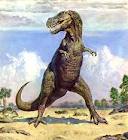
This is more accurate posture.

They were also were not slow moving or basking in the sun all day trying to heat themselves up.  Instead, evidence now suggests that they were endothermic (warm-blooded) and lived very active lives.  Alicia and I just went to the Colombo Zoo last weekend and, let me tell you as pedantically as possible, it is no fun to watch lizards.  They don’t do shit.  Monkeys, guinea pigs, and birds are great; they are constantly on the move, playing games, fighting, etc.  Alicia and I even had a giraffe follow us around; we are pretty sure it liked white people for some reason (pictures to come later).

Dinosaurs have only one descendant that lives today, and that is birds.  The ostrich is perhaps the closest thing we have to a dinosaur.  (Check out Ostrich feet the next time you see them and think “dinosaur.”)

However, some of the big ones might have become more cold-blooded as they got bigger so as to substantially slow their metabolism.  This would allow a dinosaur five times the size of a full-grown African elephant to only need the energy the elephant needed.  In other words, on African safaris, we would see just as many animals, but they would all be bigger.

There really could have been enormous plant-eaters everywhere.

When were they?

This prof was a Wheaton professor, a good ole’ evangelical school, and he was telling me that dinosaurs lived between 65 million years ago and 245 million years ago.  Many dinosaurs went extinct and evolved during that time; in fact a Tyrannosaurus Rex would have never battled a Stegosaurus, because the former was alive in the late Cretaceous and the latter in the Early Jurassic, nearly 100 million years apart.

To put this in perspective, Earth is guessed by scientists to be 4,500 million years old, but things did not get very interesting until 500 million years ago.  After that vertebrates started coming (animals with spines), than land vertebrates, and then the dinosaurs, until 65 million years ago, when they suddenly disappeared from the fossil record.  From then on exactly zero dinosaurs, except birds, appear in the sedimentary rock.

Why did dinosaurs suddenly and completely die off 65 million years ago.?

In addition to all non-avian dinosaurs, ammonites (type of mollusk), mosasaurs (large sea-faring reptiles), and many types of mammals went extint, along with plants, even a type of extremely plentiful sea amoeba.

There is evidence of two catastrophic events.  The first is a series of volcanic eruptions called the Deccan Traps.  You should know this word.  Use it in poetry and you will sound cool…”My anger is a fiery tumult mightier than the Deccan Traps!”  They are huge volcanoes which covered half of modern day India with lava flows and the whole world with dust and ash.

But the Deccan Traps’ numerous eruptions would have slowly affected the globe over millions of years, maybe even 8 million years (68-60 million years ago), which is not the sudden change that the fossil record shows.   We also need something more harmful and more immediate, which points scientists to the Chicxulub impact.

The Grand Canyon is 18 miles across.

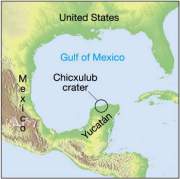
65 million years ago a rock six miles across hit what is now the southern Gulf of Mexico with a force 2 million times bigger than the biggest ever detonated atomic bomb.  It created a crater 112 miles in diameter.  It would have immediately destroyed all life in the hemisphere; the T-Rex’s that ranged over North America were all dead right away; and covered that world in a cloud of soot and dust that poured acid rain, burned off the vegetation, and killed anything that was not small enough to hide—impact winter.  It left a thin layer of sediment, the K-Pg Boundary, found all over the world with dinosaur fossils below it and none above it.  It also contains high levels of Iridium, common on asteroids and not common on earth.

An artist imagines the Chixculub impact, which vaporized all life nearby and started a nuclear winter around the world.
Whatever the Cretaceous–Paleogene extinction event was, it led to the rise of mammals, which had been living alongside the dinosaurs, but now had a wide open world to populate, and these mammals, apparently, led to us.  Ironically, there were some smart dinosaurs that possibly could have evolved into intelligent creatures.  Brain size roughly correlates with species’ intelligence, and there are some dinosaurs that had a brain to body ratio about halfway between dolphins and chimps and us.  Were there dinosaurs capable of language?  Would we have cities of dinosaurs now, with dinosaur presidents and dinosaur punk rockers?

And now for some random facts:

Dinosaurs were quite possibly extremely colorful.  Many could have had feathers.  Many could have had strange anatomical features which could not fossilize, like trunks or skin flaps.

A sauropod protects her young.

Those big Sauropod plant eaters probably did not chew a thing.  The only way their enormous bodies could be fed by such tiny heads is if they just stripped plants and swallowed.  Smooth stones have been found in the rib cages that they think were swallowed to aid in digestion, like some birds do, like Ostriches, who can swallow stones up to 10 cm across.

Because these Sauropods were so enormous, we do not know why they had such long necks.  They would have towered over most any tree that was around.  My personal theory is simple: long necks were a big dinosaur turn-on.

T-Rex’s often suffered from gout and, as one aged, probably became more of a scavenger than a hunter.

The biggest flying dinosaur had a colossal 40 ft. wingspan.  That blows my mind.  It was an actual thing!  Not some disney character.

Everyone who loves history has a moment when they realize how real history was; Napoleon and Thucydides was as real then as you or me are now.  In the last week, I was simply overjoyed to discover that this Lost World of childhood fantasy turned out to be history.  Dinosaurs really did live on this earth and roamed lands on which we all now tread—where we write and read blog posts.  (I even categorized this post under ‘History.’)

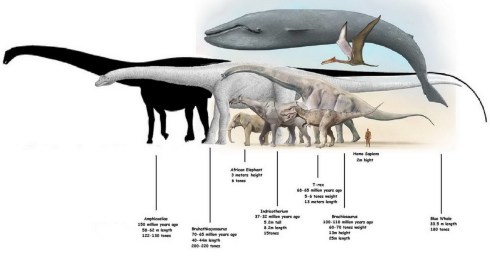
And we still live in the age of giants.  The biggest animal ever, at 180 tons, happens to be  around today: the blue whale.
Cool…


…just some comments on gun control

A gun-owning friend of mine who read Mass Murder’s Bright Future had this to say:

One of the things that I think warps peoples view is not understanding people who are avid hunters and shooters. I have read time and time again about people who had a cache of weapons or ammo only to find out the person had a couple of handguns and a few hundred rounds of ammo. To a person who doesn’t shoot 200 or even 500 rounds of ammo may seem like a lot to an avid shooter that is an hour or two at the range on a Saturday morning. For some owning dozens of guns is a pretty normal thing. I hope this doesn’t make you think less of me but I have ordered A LOT of ammunition through the internet.

The reality is gun ownership is on the rise in the country and violent crime is on the decline. There is not much political will to really change gun laws. The assault weapons ban ended and while there was a prediction of blood in the streets crime rates still went down. Politicians know there is nothing to win and quite a bit to loose. It seems to only play well with progressives I know a LOT of liberals who are pro-gun or at least agnostic to them.

The reality is that laws only effect those who follow them ask me some time about the ridiculous hoops one has to jump through. It defies logic. The criminals don’t jump though the hoops. The mentally ill don’t either.

The world isn’t safe it is a fact but I personally am not willing to give up any freedom for the perception of safety.”

This exchange about gun rights interested me:

“This was an otherwise law-abiding person who snapped. This wasn’t a case of a known criminal or known wacko getting guns when he shouldn’t have. Its the risk associated with living in a free, armed society. Yes, incidents like this are tragic, but i’m not going to give up more of my rights just because a couple people died in a random act of violence.”

Response:  “maybe if it wasn’t so easy for these law abiding people who can potentially snap to have guns, or if there wasn’t a culture of paranoia making people believe they need guns to be safe, this wouldn’t have happened. You are being stubborn about what you perceive to be an essential right, while people continue to die in these “random tragic acts of violence”, and other countries who have stricter gun controls laugh at you. This is not the Revolutionary war, or the zombie apocalypse, or any of these scenarios you secretly hope happen so you can justify your ownership of firearms. You’ll never use your gun for anything useful, you’ll never be the hero in your own Rambo fantasy where you save the neighborhood. Sorry to shatter your dreams.”

I love that rant about Rambo!  I think it is unfair, but also not completely untrue either.  Here’s another one about the incredible disconnect between gun owners and others:

“If I had been there, he would have been neutralized within seconds. I do not go to the movies because my legal gun is not welcome. Sure, take away more rights. That will solve everything.”

Response: “You are scary.”

I’m glad to see Obama has started talking about guns.  Discussion is good.