Author Archives: Jer Clifton

About Jer Clifton

Unknown's avatar
Look up, friend. The world is too beautiful for my eyes alone.

Inspiration Oak

In 1492, the day before Christopher Columbus stepped onto the wet sandy beach of a new world he thought was India, a very insignificant event took place.   If Columbus would have kept going east, past the bahamas, over the gulf stream, and around the Florida peninsula, he might have discovered it–a fresh, tiny, young shoot that had just broken through the topsoil of an entirely pre-european continent.   Of course, Columbus, or anyone really, would not have cared, and would have easily and indifferently trampled it underfoot.  But, over the next few years, this shoot managed to avoid getting trampled or blown over by storms.  It grew in that little piece of what is today Alabama that juts down to the sea between Florida and Mississippi.  The plants there suffer through hurricanes at least once every few years.  But this little live oak survived.

In its youth, the world around it likely changed little, but in fact it had been claimed by a Spanish king.  It grew into a sturdy tree and endured more hurricanes, droughts, and fires, and Native Americans would stop and rest in its shade.

In its 27th year, in 1519, Cortez landed in Mexico.

In its 129th year, not too far away, Pilgrims and Native Americans shared the first Thanksgiving feast.

In its 284th year, in 1776, some self-evident truths were declared.

In its 327th year, in 1819, its ownership was transferred by the Spanish King to a young United States of America, and it became part of the new state of Alabama.

In its 373rd year, General Robert E. Lee surrendered in an obscure courthouse.

In its 453rd year, on V-J Day, August 14th, 1945, this picture was taken: 

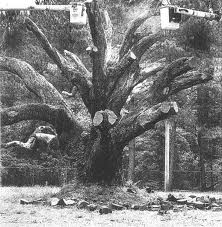
Twenty two years later, in the oak’s 485th year, this picture was taken of the live oak itself:

At this point the Oak, now called Inspiration Oak, had become famous and a hallmark of Baldwin County.  Though it was owned privately, Baldwin County was going through the process of buying the land for the use as a public park.  The owner was outraged at how little the County offered for the property, and purportedly was the one who, late one night, took a chain saw, and cut a ring through the bark all the way around the tree.   The community was devastated, but A Save the Tree committee was formed, thousands of doallars were raised, foresters were brought in to attempt to graft bark across the gash, AmeriCorps members organized the community, Tibetan monks came and blessed the live oak, and 15,000 visitors came a month to watch the ongoing effort to save the tree.  But it was no use.  The tree was dying.

In the Oak’s 509th year, around 9/11/2001 when our country was the victim of international terrorism, the tree died.

Two years later, in 2003, in the oak’s 511th year, the tree had become too much of a safety hazard, and it was cut down:


What’s my point?  I am not sure.  History is cool…and I like big trees…and I like old things.

JRR Tolkien loved trees. Anyone who loves history, age, myth, and all things ancient has to adore trees.  I love how they are so incredibly tied to their communities.  They are 100% committed.  They cannot move.  In the Silmarillion, the god of the trees makes Ents to protect these huge, ancient, and helpless creatures.  In the real world, Ents do not exist, and even if they did, they would be ineffective.  Humans are incredibly powerful, and can destory so much so quickly, with war, hijacked planes, or chainsaws.  We must do what we can to protect all valuable and helpless things.  Many of those valuable objects are that which connect us to our past.

I stumbled upon the Inspiration Oak story as I was looking through some of Habitat’s old National Service files a few months ago, and, for me, it immediately became a precious, rare connection to a pre-european America.  Its passing feels something like hearing that a WWI veteran died.   It strikes me in the face; so much of the past was not so long ago, and so much of what was not so long ago lives today in our homes for Seniors, our forests, and everywhere we look.  We really need to just keep our eyes open.

Beauty, specifically really cool history stuff, is everywhere.


The Modern Male Malaise

Nationwide, boys have poorer reading scores than girls, they are five times more likely to commit suicide, two and a half times more likely to drop out of high school, and, as of 2008, women accounted for 59% of all those enrolled in graduate school.  In January of 2010, for the first time in history, America had more women in its workforce than men.   There are now more females in med school and law school, two traditionally male-dominated professions.

This is not yet a tsunami.  There are different ways to look at the numbers.  For instance, more men still graduate from four-year colleges (29.5% of males versus 28% of females).  But trend projections make it seem likely that will soon change too.  In all, the image surfaces of western women on the rise and western men on the decline.

Now why is this happening?

I think there are a number of reasons.  First, people I trust tell me that the educational system disadvantages men.  It has something to do with how boys learn and how girls are better verbal processors sooner.  Secondly, I fault the lingering momentum of feminism.  Societal change has come about so quickly that many, especially those in the older generation, have not realized that it happened, and so they continue to advocate for the empowerment of women generally and everywhere as if they were still living in the 1950s.  I am for the empowerment of women, very much so.  But in broad sections of American society today, feminism is not necessary anymore.  In fact, it can be hurtful.  Generalized prescriptions quickly become stupid in a world and a country as large and complex as ours.

But what really interests me is another factor which is rarely discussed and seems to draw some ire.  It has to do with the relative uselessness of physical strength today.  Of course, strength is still useful for a number of things.  After all, boxes need to be moved and jars need to be opened.  However, such relatively meaningless activities serve to underscore how truly unimportant strength has become, especially when one ponders, just for a minute, how important it used to be.  Here we enter an alien world: the vast majority of human history.

In a world without guns, police, and communication technology, nearly all of the population existed in a state of what might be called quasi-anarchy.  Roving tribes attacked each other and the governments that did exist were not overly committed to protecting civil rights.  If you lived anywhere you likely lived within a tribe.  You would be completely reliant on the strong individuals in your tribe, specifically in your immediate family, to protect you, from wild animals, bandits, other tribes, etc., and those that could provide security naturally enjoyed a place of social prominence.

This old world was much closer to the state of nature that worried Thomas Hobbes, where life is “nasty, brutish, and short.”  It sounds awful.  I am glad I did not live back then.  But, because the challenges of staying alive were what they were, physical abilities were highly cherished.

Understanding this old world makes some sense of weird institutions like polygamy.  Today, polygamy is perceived to be an incredibly sexist institution–end of story.  But the truth is more complicated than that.  Undoubtedly, polygamy was used as a means to acquire women as if they were property, but it also served to protect women.  If you were a woman, living in this old world, how safe do you think it would be to live on your own?  In fact, women often begged men to take them in as a second or third wife when their own close male relative died.  If I was alive at the time, I feel that I would be morally obliged to acquiesce.  Does that mean I am sexist?

So, for thousands of years, maybe hundreds of thousands of years, maybe millions, men evolved and competed against themselves, as was encouraged by men and women, to better fill this perpetual need to be strong and protect.  Deep-seated cultural and genetic adaptations developed that created an abiding drive in men to address this need.  How long, do you think, does it take to undo this hardwired tendency?  If it is possible at all, I would guess it would take a while.  How long has strength been comparatively useless?  Maybe 50 years?  Unfortunately, this is the same 50 years that has seen the rise of feminism.

Of course, society has been getting progressively safer long before the 1950s, and thus women and men have been increasingly less concerned about having strength for the purposes of personal protection, especially in cities and among higher-class society and occupations.  Nonetheless, for most, strength continued to be important for work.  Sailors, soldiers, farmers, etc., needed to be strong.  To get a sense of how strength was valued, consider that in 1900, 70% of Americans farmed and lived on farms.  In 2000, that number is 2%.  Certainly, hard work is as necessary today as it was 100 years ago, but weak legs are as good as strong ones if they are simply under a desk all day.

I have been reading a biography of Abraham Lincoln.  As a youth, he became well known and respected for, quite simply, being good at splitting wood.  Almost two centuries later, chopping wood, and talents like it, are rather quaint, even cute.  Taking pride in such abilities seem childlike.  Of course they do.  Fox cubs play chase and wrestle with each other in part because it helps them develop the talents that they will need in order to survive as adults.  I imagine that our forefathers who survived a harsh world were selected in part by how their childhood games prepared them for life.  This same sort of play, the desire for children to play this way continues, but the purpose for the play is gone.  Today, lots of boys play sports, grow up, and discover that the main talents they pursued, such as physical fitness, agility, speed, coordination, are mostly useless in the real world, and the other talents that came as a byproduct of sports, such as teamwork, communication skills, and perseverance, are much more valuable.  Is it possible to switch?  Can we push kids to pursue useful things and have the byproducts be the useless skills like throwing a ball through a hoop?  Can we reform play in order to help prepare our children for being adults in a different world?  What is clear is that men have not only inherited the adaptation and desire for physical strength, we are also raised to excel in these now-useless abilities.

Really, I have no answers and nearly everything in this post is speculation.  I also should give a caveat: I am a former captain of my varsity soccer and wrestling teams.  For people like me especially, the discovery of the meaninglessness of sports and strength can be rather shocking.  It made me ask, “Tell me again, why was I led to believe this mattered?”

This much we know: it is going to be very difficult to get men to stop caring about feeling manly.  Civilizations that are successful will find ways to use this drive productively.  Fortunately, there is more associated with manliness besides physical abilities.  Maybe we can emphasize those other qualities:

If you can keep your head when all about you
Are losing theirs and blaming it on you;
If you can trust yourself when all men doubt you,
But make allowance for their doubting too;
If you can wait and not be tired by waiting,
Or, being lied about, don’t deal in lies,
Or, being hated, don’t give way to hating,
And yet don’t look too good, nor talk too wise;

If you can dream – and not make dreams your master;
If you can think – and not make thoughts your aim;
If you can meet with triumph and disaster
And treat those two imposters just the same;
If you can bear to hear the truth you’ve spoken
Twisted by knaves to make a trap for fools,
Or watch the things you gave your life to broken,
And stoop and build ’em up with wornout tools;

If you can make one heap of all your winnings
And risk it on one turn of pitch-and-toss,
And lose, and start again at your beginnings
And never breathe a word about your loss;
If you can force your heart and nerve and sinew
To serve your turn long after they are gone,
And so hold on when there is nothing in you
Except the Will which says to them: “Hold on”;

If you can talk with crowds and keep your virtue,
Or walk with kings – nor lose the common touch;
If neither foes nor loving friends can hurt you;
If all men count with you, but none too much;
If you can fill the unforgiving minute
With sixty seconds’ worth of distance run –
Yours is the Earth and everything that’s in it,
And – which is more – you’ll be a Man my son!

-Rudyard Kipling, If 


A Love Story

This is likely my most foundational myth.  I share it now because of its relevance to my last post.  Click on the “My Myths” page above for more info about what these myths are all about.  

Most expats in my community headed back to the States during the lazy summers of High School.  The ones who remained were at the pool everyday.  Among them were Coach Harris and his progeny, who at the time numbered five.  They couldn’t afford seven plane tickets anywhere, so instead they kept us in business.  Everyday I watched them swim from my perch atop the lifeguard stand.

I think the main reason why some people did not like Coach Harris was because they didn’t know what to do with him.  He had all these cute kids, but he himself was big, bald, buff and scary.  He appeared taller then he really was.  He kept his head shaved because he had started to go bald in his early twenties and didn’t want to deal with it.  He taught high school math and was intelligent, but he was also quite emotional, dramatic, and judgmental.  He wasn’t mean, brutally honest to a fault perhaps, but not mean.  Once he screamed at me when I lost a big wrestling match and called me an idiot, but I don’t hold it against him.  He was caught up in it.  I think most people did not like him because he neither said hello nor smiled when he passed you on the sidewalk.  But his intensity and the fear he inspired kept us wrestlers in shape and his four little boys in tow.  Now his wife had just given birth to their fifth: a girl.  Some people feared for her.  How would this guy raise a daughter?

Once or twice I wondered this myself as I watched the Harris boys jump off the boards.  They loved the diving boards.  Coach would often join them, teaching them how to make big splashes, dive, and do flips.  But for hours after Couch would retire to his big towel shared by his wife and little daughter, his sons’ ceaseless jumping would keep wet a closed circuit on the pavement from the pool to the boards.

The three eldest took great pride and pleasure in jumping off the twelve foot high dive.  But the youngest was still too scared.  Elijah was four, scrawny, and ridiculously cute.  One day he turned his over-sized head and cast his big brown eyes on the high dive.  He wanted to join his brothers.

“Daddy, can I jump off the high dive?” he asks, staring up at the board.

“Are you sure son?  It’s pretty high,” says Coach.

“Yeah, but I want to.”

At our pool nobody is allowed to climb down the high dive ladder.  It is too long, wet, steep, and slippery.   Of course, most lifeguards, myself included, were not martinets about it.  But Coach squats down, looks his son in the eye and says, “It’s your decision Elijah, but I want this to be clear: if you decide to go up the ladder, the only way down is jumping.  It’s the rules.  Are you sure you still want to do this?”

“Yeah.”

“Great.  If you think you are up to it, I think you are too.”

Elijah slowly starts to climb the ladder.  Caleb, the eldest, looks concerned.

“Are you sure Elijah?” he says. “Won’t you be scared?  It’s pretty high.”

“I can…do it,” Elijah mumbles.

The steps on the ladder are too big for him, but after some awkward climbing he arrives at the top and beholds the world from twelve feet up.  His eyes pop.  There is no place higher in all the world.

After a few short seconds he musters his courage and begins to inch his way slowly down the board.  His arms are not long enough to reach the railings on both sides so he grabs the right side with both hands and walks woodenly sideways in his sopping red swim shorts.  But he quickly runs out of railing and faces the board’s lonely extension into oblivion.  The panic starts.

“Dad, I’m scared,” he said.

“You can do it,” Coach calls back, “I believe in you.”

Elijah’s brothers join his dad on the side.

“You can do it!”

“Go Elijah!”

With knees wobbly, Elijah slowly lowers himself to his hands and knees.  He painfully relinquishes the metal rail and starts to crawl forward.

As the line behind the high dive grows, I worry that being the lifeguard on duty I might have to expedite matters.  But impatience thaws as those in the line become invested in the delightful drama of this little guy’s jump.  They join the cheering crowd.

“Come on buddy!”

“You can do it!”

As Elijah journeys down the board, his crawl becomes slower and slower, and he hunkers lower and lower, until he is finally lying face down, at the end of all things.  With his nose pressed into the sandy-textured surface his eyes peep over the edge.

“Daddy, I don’t want to do this!”

Coach replies, “You have to buddy.  Now stand up.”

At this point, patrons from around the pool find themselves congregating around Coach, adding their voice to the encouragement.  Through the power of cheer they hoist Elijah to a crouch.  Then they start the “one-two-three-jump” routine, but when they get to “jump” Elijah remains motionless, tense, his big eyes staring at the water.  After a few disappointed seconds they start again, but at “two” they stop.  Elijah has burst into tears.

“Daddy, Daddy,” he says through chortled gasps, “don’t … make …me …. do … it. I’m scared, I don’t …want to.”  His knees now shake uncontrollably, and his nose is running.  The mood of the crowd begins to alter.

“Ok, that’s enough.  Get him down now,” an older man barks.

Coach whips him a look that shuts him up, but as time ticks on those looks become less effective.  Some of the crowd’s cheers for Elijah become muttered jeers against his father.  I feel that it might be gracious to provide an opportunity to end this.  I began to speak, “Elijah, its OK.  You can climb…” but coach gives me a glare, and my voice trails off.  He was scary and bald.

But Elijah still won’t jump.  The exciting and uplifting drama that had brought in the crowd and stalled the impatience of those in line was now becoming the grotesque sight of an ill-tempered father needlessly torturing his son.  The crowd thins.  Many give up on jumping off the boards in order to escape.  I feel it too, the way you want to hide in your chair when someone on stage is embarrassing themselves, the way you want to turn the other way when a child is being spanked in public.  Those who stayed either donned a grim face suitable for watching parental inadequacy or became vocal hecklers.

“Why are you doing this to him?”

“Somebody needs to get that kid down.”

As Elijah continues to sob, the crowd focuses on Coach, and as Coach’s looks grow increasingly ineffective, he turns to his son.

“I believe in you Elijah.  You can do it.  Jump!”

But when chokes and sobs progress to delirium, the crowd turns from Coach to me.  The second time I open my mouth Coach raises a hand, “Please Jeremy,” and while looking up he says,

“Son, I love you.  You made a decision to climb up that ladder knowing that you would have to jump.  I am going to hold you to your word.  You can do it.”

At several points during this entire spectacle Elijah ran back to the railing, once as far as to the top of the ladder, but he always came back.   When his Father says these last words Elijah is at the edge of the board again.  Elijah responds by taking a few breathes and calming himself a bit.  Then, during a lull in the cheering, while most are focused on denouncing Coach and I, while I am absorbed in figuring out how best to salvage my own reputation in the situation, Elijah crouches a little lower.  Then, with body tense, hops lightly off.

Splash!  The crowd goes wild. Elijah himself comes up out of the water with a grin big enough to match the size of his eyes.  Pure joy.  His brothers help him to the side.  “That was so cool!” Elijah squealed as he clambered out.  His father kneels in front of him.

“Son, I’m so proud of you.  I knew you could do it.”

“Thanks Dad,” Elijah squeaks and quickly pulls away.

“What? Where are you going?” Coach asks confused.

Elijah turns as he runs, “I’m doing it again!”

Elijah spent the rest of the day jumping off the high dive.  The crowd dissipated.  Coach and even Elijah’s brothers eventually left him to make his own closed circuit on the pavement.  But I stayed at my post until the pool closed watching this child and pondering his transformation.  It seems to me that my graciousness and the crowd’s compassion would have had Elijah ashamed, crying, huddling with his mommy and baby sister, wrapped in a towel and sucking pulpy juice through a straw while silently watching his brothers jump off the boards again and again without him.  It seems that only his father really loved him, and that enough to stand up to the crowd, to stand up to the lifeguard and, above all, to stand up to his own son’s tears.  What is love which damages its object?  What is love when it is motivated by the immediate gratification of our emotional “philanthropic” insecurities?

What is love?

I pondered all this and more high aloft in my sun-baked, concrete tower.


Old Jer Idea #1: Real Rough Love

There are a number of serials I want to start, one being an “Old Jer Idea” series for ideas I have been talking about for years.  These are tried and true monologues, not unlike my myths, only less entertaining and more pedantic.  You’ll love them.  

Alicia keeps telling me that I should write a book about my approach to relationships, confrontation, and love.  I think that the fact that this suggestion is coming from my wife warrants an immediate book deal.

If I did write this book, I think my first tenet would be my definition of real love: love concerns itself exclusively with the object of love.  Real love tries always to reach past the words and space that divide us in order to understand and comfort the loved one’s inner space.  Love cares about the inside.  This is simple, but devastating in many ways.  Obviously, the biggest implication is that we have to allow others to love us by verbalizing what is going on in our heads.  This means honesty, and invariably, some rough conversations we call “confrontation.”  I have lots of ideas about how confrontation should be done, indeed it is a difficult skill, but talking about confrontation does not interest me at the moment.  Instead, I want to explore a very specific pitfall in relationships.

Most of the roles we hold dearest to our sense of self are our functions as wife/husband/parent/child/friend/etc.  Unfortunately, many of us desperately need to be good at those roles, and we set our hearts on a certain image of ourselves.  To keep our realities in tact, we refuse to entertain the possibility of failure by resisting any indication that we have mismanaged our role.  This forces those that we love to become actors and actresses in a tedious play designed to convince the “loving” person, perhaps Exemplar Edgar, that he is a great husband.  But by insisting on this farce, Edgar’s loved ones come to despise him, for every day he rubs the truth in their face, “I care more about my self-image than you.  Why else would I be so willing sacrifice your happiness and my relationship to you in order to preserve it.”

Of course, while some people resist criticism to the bitter end, others immediately break down and beg forgiveness for being an awful, despicable person.  Both responses are monumentally worthless and a middle course between the two, or oscillating between them, is just as bad.  Being 50% self-deprecating and 50% self-preserving is still being 100% self-focused.  Instead, love, concern for what is going on in the other person’s head, requires a certain amount of maturity, of being secure in who you are, of being able to think from another’s perspective, so that you can forget about yourself for a moment.  Why have they come to me?  Why are they hurt?  Why are they afraid?  What underlying fear are they worried about and how can I address it?  Do I understand what they wanted to say?  Have I expressed that I understand?  Etc.

If being loving is only possible after being secure, does that mean that insecure people are incapable of love?  In short, yes.  It depends on how and why one is insecure, but overall, I think so.  Many, maybe a third of us, I do not know, have probably never loved someone in our entire lives.  Of course, the insecure person might be capable of love in the sense that at some level he cares about another person, but caring and valuation is always a comparative enterprise.  We prove our love when something we are insecure about is threatened, but we choose to listen and ask questions.  Otherwise we love conveniently.

So who do you love, and who do you love conveniently?  As you think about the people in your life, a good barometer is how easily and often honest conversation and confrontation happens.

Hmmm… I have some people I need to chat with.


Lovesick Reflections

In 10 hours I get to see Alicia after 10 weeks and one day of being apart.  At first, reverting to bachelorhood was a party.  I ate meat, played board games, got lazy about recycling, and drank beer.  Actually, I drank more herbal iced tea than beer, but the point is that I did very manly things.  But after the first month I began to experience severe symptoms of what I suppose would be best diagnosed as lovesickness.  My best friend, my lover, was far away.  But as the day approaches weariness has given way to  excitement, or to be more accurate, excitement has been added to weariness.  Last night I was so jazzed to see her I could not sleep, not a wink, and as I lay there in the dark thoughts crashed over me, eventually overwhelming my heart with a profound sense of blessing.  I got up determined to share these thoughts with you.  (So please pardon any sleepy verbosity you might encounter.  I am writing in a sleep-deprived stupor.)

A good friend of mine, Ben Walker, had to bury his mother recently.  It got me thinking about death and bereavement.  Comparing my bereavement to his is about as ridiculous as comparing a pinch to losing a leg, but it has nonetheless provided helpful perspective.  Because it is a perspective constantly eroded by the grind of our daily banality, it must be reestablished from time to time and for me it happened last night.

Obviously, losing a loved one or being separated from them is only excruciating because we care.  A very easy solution would be to never love anyone, care for anything, or enjoy anyone.  If we did that, if such coldness was possible, the day your father died would be just another breezy summer day.  But for humans, you and me, we grieve, we wail, we cry, we ache, and all of it heaves deep within our chests and stomachs.  Frankly, I find this response  to loss very encouraging.

Loss is only capable of causing pain when we have something good to lose.  Loss reveals what we have been enjoying this whole time.  It allows us to see how those we lose are enormously precious to us.  This morning this idea overpowered my brain until I felt nearly unbearable levels of gratefulness as I ached to see my wife.

Loss helps us in another way.  It gives us insight into other relationships.  Loved ones do not magically become important to us because they die or go to Rwanda.  If so, living loved ones and nearby loved ones, are likely similarly connected to us.  Imagine a farmer who goes out to the field to check his carrots.  He can’t see the carrots underground, so he pulls one up, roots and all, and then has a pretty good guess about the state of his other carrots.  Bereavement pulls up one of our carrots, and that process sucks, but it also provides an opportunity to see the likely depth of other relationships.  We should not waste it.

Those of you who have read Therefore Joy already know that one of my big mantras is that humans universally possess an embarrassingly pathetic understanding of the enormity of good in the world and in our lives.  We do well when we widen that understanding and share our insights with each other.  The widening thought that hit me in the face this morning, not for the first time and hopefully not for the last, is pretty simple: I enjoy this girl so much that just the prospect of being reunited with her makes me too excited to sleep.  These roots run deep.

Alicia will die on me someday, or I will die on her, and one of us will see the roots pulled out, and it will be awful.  But until then, I want the presence of mind to see and appreciate our deep love and enjoyment of each other.  I want to treasure her affectionately before I lose her.  My hunch is that it will make the good times even better.

In other news, my goal this summer was to finish sending Therefore Joy in to publishers by the time Alicia got back and I did it!  I feel 10 pounds lighter.  


The Debt Ceiling Debacle and the New Political Order

In debacles of this sort there is usually plenty of blame to go around, but, this time, the majority of the blame is uncharacteristically concentrated.

Since 1917, the debt ceiling has been raised 102 times.  From what I can tell, these raises have been more or less bipartisan and routine.  More recently, both sides have flirted with playing chicken with the debt ceiling.  Indeed, Reid’s, Durbin’s, and Obama’s voting records in the Senate were nearly perfectly partisan, as they voted against raising the debt ceiling when Republicans controlled the Senate, and for it when Democrats were in the majority.  Shame on them!

However, the Democrats as a whole never really came close to stopping a debt ceiling raise except for a couple times under Bush (under whom it was raised seven times) when the votes were close.  Overall though, it is fair to say that debt ceiling nay votes were cast on both sides of the aisle nearly exclusively to make a political point.

This changed in 2009.  Here’s some numbers: 55 republican senators in 1997 voted for a debt ceiling increase, then 31 in 2002, then 50 in 2003, then 50 in 2004, then 51 in 2006, then 26 in 2007, then 34 in 2008, then 33 again in 2008.  In 2009, 2 Republican Senators voted in favor of it.  For the second time in 2009, there was 1.  Finally, in 2010, there was 0.  This is how things stood when Republicans took back the house and a showdown was set.  Furthermore, the Republicans returned to power in large part because of the rise of the Tea Party, the majority of which, and please correct me if I am wrong here, see compromising as unprincipled behavior.  No longer were the days when a few errant politicians used the debt ceiling to make a point.  Now it was, “give us what we want or we’ll blow the country up.”  Certainly, both parties were headed in the direction of giving this ultimatum, but the Republicans got there first.

This put the Democrats in the position where they would have to choose between default or letting the Republicans take control of government.

What would you do?  The Democrats, from what I could tell, mostly gave in to Republicans, but they did it too late, so we still had a credit downgrade.   If I was President, maybe I would have fought crazy with more crazy and said, “The debt ceiling is sacred.  If you attach any conditions on raising the debt ceiling, even if it is one lousy $25 appropriation for free Fritos at a movie night for disabled children of veterans who also happen to be Hurricane Katrina survivors, I will veto it.  I do not care.  Don’t f#ck with me.”    But who knows if that would have worked.

What all of this does reveal is what I see as an ongoing fundamental shift in contemporary politics.  While Republicans are being monopolized by their extreme right wing, especially the Tea Party, the Democrats are not being monopolized to the same extent by the extreme left.  What this means is that every moderate in America is now left with a choice: Am I a Democrat or not?  Regardless of your answer, moderates will be Democrats practically, but will bolt as soon as the Republicans uncrazy themselves.  Indeed, I am proud to be one of these reluctant Democrats.  With this perspective, I start to feel sick watching a slew of “I told you so” grins on the faces of 2012 republican presidential candidates.  You get the sense that, after breaking the government, Republicans are claiming, “See, government doesn’t work, so we should make it smaller.”

Yet Obama seems to be getting most of the blame, even from Democrats.  Sometimes it makes me think I am taking crazy pills, “Why do people hate this guy so much?”  and it gets me thinking that maybe I should hate him too.  Why doesn’t he stick up for himself more?  Why isn’t he as disappointed with this process as I am?  Why is he so quick to compromise?

And as I lie here, asking those questions, and thinking about the 2012 election at 7AM, I found this video and I realized this: Obama is still the man.    Seriously, watching it was a spiritual experience.

My conclusion: I need to calm down.  Everyone needs to take a breath.  It’s going to be OK, and we all need to keep compromising.

“Compromise” shouldn’t be a dirty word.  Alicia and I compromise with each other when we disagree.  If we do not, we jeopardize our marriage.  If politicians do not compromise, they jeopardize the country.  But, if they do, for many of them, they jeopardize their job security too, and this gets back to my point about the new political alignment: Republican politicians are dependent on people who think compromise is villainous, and that’s why, right now, all moderates are Democrats.


Am I Sexist?

I am not sexist.  Really, I am not.  Also, I have never google-image searched naked pictures of the T-Mobile girl and/or tried to friend her on facebook.  But denials have a curious way of making people wonder why they are necessary.  Indeed, some have expressed concern over my alleged sexism, especially after watching my Fox5 interview.  Towards the end I make this unfortunate statement which, quite understandably, I have been asked to explain: “I also think I’m not special in this [this pulling people off the third rail business].  I think there are tons of men and boys out there that would have done the exact same thing.”

Yup.  Men and boys.  Exactly.  Good thing they did not include the rest of the interview, cause I go on to expound on how all women and girls are worthless cowards.  No.  That is not a true story.  The host, Angelique Proctor, understood what I meant when she said, “Jeremy…believes any of us would have had a similar reaction.”  So why did I say “men and boys”?

Obviously, cause I was a tad stupid.  I cringe when I hear the line.  Alicia cringed too while watching the interview from the other side of our living room.  This was my first interview, and my worst.  I was clueless.  This experience makes me extremely patient with celebrities and politicians who get in trouble because of sound bites.  I have been saying for years that if I was a celebrity I would get caught saying idiotic things all the time.  And, in my fifteen minutes of fame, I proved myself prescient.

Fortunately context saves me.  Often it will not.  I do, in fact, consistently say dumb things.  But this time context saves me.  At the beginning of the interview Angeligue had asked me why I grabbed the guy.  In my answer, I talked, among other things, about how I had been an adventurous, daydreaming boy, who often imagined the day I would rescue damsels in distress on a semi-weekly basis.  As I grew older and started lifting and working out, ostensibly for sports, I knew it was in fact secret superhero training.  Though overstated, I think this rings true for many other boys who, like me, grow up to be men but never quite lost those specific daydreams.  There are lots and lots of us out there.

The “men and boys” comment was meant to bring this context to bear in order to support the broader point that there are many others who would have acted similarly.  Some of these people would be, I think, the people who had developed the silly and noble psychosis that I had.  So I was in fact making fun of men and boys a bit, and my comment was inclusive, not meant to exclude others from being brave, but to note that one of the groups that would be brave in these sorts of situations is a group I have already mentioned.  Of course, none of this was clear from the interview.

There are those who had concerns before the “men and boys” comment.  I certainly hold beliefs and ideas that some find sexist-ish and I espouse them liberally (or conservatively?).  I do not think they are sexist, and Alicia does not think they are sexist either, at least not usually.  I plan on blogging about them and the reader can decide for his or her self.  In the meantime, please accept my apologies if you were offended by my comment on Fox5.  I assure you, in this case at least, I was not sexist, but merely dumb.


Fire

After I first began lifting weights and started getting pretty buff, I was ready for music camp.  My mom was always trying to get me to go to camps.  I hated going because I stuttered.  I would have to introduce myself and stutter on my name, then they would think I’m either stupid or telling a joke, which for me amounted to the same thing.  But Mom would make me go anyway.  Though it was hard, today I am thankful for her kick out the door.

One of the last nights of music camp they built a bonfire.  The flickering light emboldened me to strike up a conversation with one of the girls I had a crush on.   Anna was as gorgeous as a 7th grader could be, and I suspected that she was interested in me too.  But as we were trying keenly to entertain each other, another guy makes a move.  He walks up and makes as if to join the discussion.  At that moment I am saying something and stuttering heavily.  He chimes in with a loud, dull voice, “st-st-st-st-stupid.”

Anger rises in me.  Thoughts flutter in my brain.  “He’s mocking me…my stuttering…he’s mocking me about stuttering in front of a hot girl…he’s small and annoying.”  In a flash of rage, I see a vision of myself grabbing his belt buckle with my near arm, grabbing his collar with my other hand, pulling him towards me and, in one smooth motion, turning him upside down and throwing him into the fire.  I lean towards him with my hands tense.

I pause.  “Holy crap,” I think to myself, “I am going to kill this kid.”

I realized something about myself that day.  I was now powerful enough to do real damage.  A child can get mad, throw tantrums, and punch blindly with consequences amounting to a handful of bruises at most.  But the tantrums of men can kill.

Anyway, though I didn’t throw him into the fire, I still got the little bastard.  Anna was disgusted by him and sympathized with me.  Stuttering always gets the girls.

This is another myth.

 Also, I wanted to say thanks to all that responded, privately and publicly, to the “Loved in Hell” post.  And in other news, Alicia gets back in less than 2 weeks!  


Loved in Hell

Can loved ones be in hell?  I think everyone who believes in hell would say, “Of course.”  But this poses some logical problems for me.

In Veggie Tales’ Jonah, the Pirates Who Don’t Do Anything define compassion for us: “Compassion is when you see that someone needs help, and you want to help them.”  It could also be said that you “let someone else’s trouble trouble you.”  But how do the troubles of those in hell not trouble those in heaven who, I assume, tend to be loving, compassionate people?  Is heaven possible in a world with a populated hell?

In The Great Divorce, CS Lewis wants to say it is.  It is possible to love those in hell, which in his grand metaphor is a greytown filled with those determined to hate the world and themselves, and not to be made miserable by that love, even if they are our dearest loved ones.  Lewis wants to say that if there is a hell then the Veggie Tales view of compassionate love does not work, because then hell would hold heaven hostage.

My trouble is that the Pirates Who Don’t Do Anything have a good definition.  My understanding of love seems to necessitate letting others hijack your emotions.  As Mr. Holton, my 9th grade English teacher, said about having kids, “It’s like letting your heart walk around outside your body.”  That makes sense to me.  That is how my marriage feels, or having good friends, or having a god you love, or a dog you cherish, or loving anything at all ever.  A true lover cannot care about the self-inflicted emotional distress of those they love without that distress in some way translating into distress for themselves.  Distress is distress even if deserved.

Because love connects us, in a world of hate, all suffering is local.  It’s quarantined.  In a world of love, pain rides veins of sympathy, slowly spreading throughout the world to make us all miserable.  Maybe God made the world that way purposefully.  If we all loved each other, joy and misery would be universal.  That also means that those veins of sympathy would intertwine heaven and hell.

So, is compassion not good, or does it somehow become not good after Judgement Day?  Does compassion need to somehow accommodate corollaries (for example, another’s troubles only bothers you when they are not self-inflicted or deserved)?  How can it?  Will we not have real compassion or love for people in hell?  Or, will hell be empty?  I have no answers.

Maybe God cuts people off from his love because he loves others and must be allowed to be happy for their sake, otherwise the pain of the former will spread.  Maybe hell could mean being completely forgotten.  I cannot have compassion on someone if I do not remember they exist.  But while God can make me forget, can he forget?  I doubt it.  Even if he is the only one who remembers that there are people in hell, wouldn’t his love of people who are getting tortured torture him?  Is heaven good for us and miserable for God?

I think the magnitude of suffering dictates in part how bad we feel for even self-inflicted pain.  Lewis’ “greytown” seems less awful than fiery torment.  Even if fiery torment is self-inflicted, if we love them in any meaningful sense, we will feel bad, right?  Aren’t we called to love our enemies?  Is it a big step from that to love the damned?

But maybe my definition of love is incomplete.  Maybe more central to love is caring about someone else’s wellbeing more than your own.  In doing this, you throw yourself wide to the afflictions of compassion, but misery is avoided, because this sort of love is impossible without something else: a radical humility. You cannot care about someone else more than yourself if you care for yourself an infinite amount.  Have you ever been loved by someone who is not humble?  You haven’t.  It’s impossible.  Humility makes love possible, and part of humility is not taking on cares and woes that are not yours.  You are not responsible for everything if you do not think of yourself as having power over everything.  “My yoke is easy, and my burden is light.”  Somehow, maybe, by giving up on yourself, you can care about others, but that care does not pollute your happiness, because you have given up on yourself.  As Tyler Durten says in Fight Club, “It’s only after we’ve lost everything that we’re free to do anything.”  As Victor Frankyl notes in Man’s Search for Meaning, you have to give yourself up and devote yourself to some larger purpose to be happy.  As Jesus says in Matthew, “the first shall be last and the last shall be first.”

A radical humility is more central to our faith than anything else (my favorite passage is the Christ Hymn in Philippians).  Maybe radical humility is what saves hell from destroying heaven.  But at times it feels like alot of bullshit.  Christ’s call to die to self is an obnoxiously internal command.  I wish I could just do some hail Mary’s, observe Friday fasts, make a pilgrimage, and do stuff that makes me feel Christian and good.  I long for legalism.  But Christianity is an immensely internal experience.  Humility, love, faith, God…I cannot measure it, see it, record it, or describe it.  I hardly understand it.

So of course it would feel like bullshit, and of course it might be.  It just makes me crazy.

These are ramblings.  Please take them as such.  


Armrest Wars

I extend my duffel bag awkwardly in front of me, shuffle my feet, and focus on making myself as narrow as possible.  Still, I bump at least two shoulders as I walk down the aisle.  I see my seat, stuff my bag in the overhead bin, and plop down next to an expressionless, somewhat girthy, but still middling middle-aged man whose chest hair protrudes out the stretched neck of a faded blue polo.  He does not move.

Normally I love flying seated next to transfixed automatons.  I am even cool with a little drooling.  No big deal.  But this man is not situated as a man should be when accommodating another paying passenger.  He stares straight ahead, his body centered in the seat, his legs splay wide, his weight forward, his elbows out, his radius and ulna hugging the top of the armrest, and his hand curling over and gripping its end.  He had claimed the land and was not budging.  I lean towards my other armrest.  This was going to be a long flight.

We trundle down the runway, and I get a little angrier.  We take off, and I get even angrier.  He reaches with his far hand to get a bag of Cheetos from his suitcase, opens the bag with one hand, eats it with one hand, wipes his fat face with one hand, stuffs the empty bag into the seat pocket in front of him with one hand, and I feel my blood pressure threatening to blow a hole in my brain.  And what kind of person keeps bags of Cheetos in their briefcase anyway?

I get out a book and try to distract myself, but I immediately notice my elbow grazing his hairy forearm.  I relax my shoulder and our skin touches.  Interesting.  I push down gently.  Nothing happens.  A little more.  Nothing happens.  Over the next 10 minutes I pretend to read while digging increasingly deeper at 30-second intervals.  But the bastard does not move.  Harder, deeper, and into the flesh of his forearm.  I am starting to hurt myself now.  How can he stand this?

I give up, on that tactic at least, and put my book away without finishing a paragraph.  “Bring it on,” I think to myself, “let’s make this real uncomfortable.”  Slowly, I start laying my arm down on his.  It gets weird really quick.  There we are, two strange men staring at the seat backs in front of us, practically holding hands.  I hold out as long as I can before I give up and make for the lavatory.  As I wash my hands vigorously I look in the mirror.  What is up with this guy?

I poke my head out of the bathroom and immediately spy him looking out the window with both arms folded across his chest!  I race towards the seat, but I am too late.  He turns, sees me coming, and re-stakes his claim on the armrest.

I almost lose it.  I almost scream.  I almost grab his neck and break it like a pencil.

Instead I sit, awed at my anger.  Have I ever been this angry?  But why is he doing it?  What a jerk!  I am entitled to the armrest just as much as he is!  Why can’t he just fold his arms like he obviously wants to?  He must enjoy depriving me.  But why do I care?  Why does this man exert so much power over my emotions?  Is my anger simply due to my discomfort?  Probably not.  I had been a missionary kid.  Uncomfortable travelling was my life.  Air conditioning vents had dripped on me for whole flights and then doused me with a cold and muddy liter upon landing.  I had been packed into truck beds under windowless tin covers with dozens of Filipinos in the middle of July.  I had lived in airports for over a day in the eternal limbo of rescheduling.  And I had never been this angry.  Afterall, I could sit in a much narrower seat with no armrest, smashed up against the wall of the plane on one side and a horde of people on the other, with smelly air conditioner water dripping on my head every two seconds, and I know it would not bother me nearly as much as this does.  The problem, I realize, is that somebody else is involved in a specific way; he is selfishly, knowingly, needlessly, and continually, treating me unfairly.

And then something snaps inside of me.  I give up on justice.  What’s the use of it?  It is just stressing me out.  For the rest of the flight the man still does not move, and I maintain a wooden lean and shift of my body weight to accommodate him, but I am happy.  From time to time, I look at him, and barely hold in my laughter as he continues his death grip.  My back starts hurting, but it is no big deal.  It is temporary, and I am happily finishing my book.

Thanks middling man.  You were a marvelous teacher.

This is the rough draft of a new myth I wrote yesterday.  You can see an explanation of the project and a few more myths on the “My Myths” page above.