Category Archives: History, General

How One Lawyer’s Mistake Changed History

I have always thought that if it were not for Clinton’s sex life, Al Gore would have won in 2000, Gore probably would not have invaded Iraq, the U.S. would probably have better environmental policy, and the world as we know it today would be different and likely better (I’m not the biggest Bush fan).  From time to time it strikes me (and I define “strike” as a “holy shit!” moment which raises the eye brows to their maximum height for a solid five seconds) how one person’s libido could be so geopolitically potent.  But apparently, though Clinton’s private behavior was scandalous, it was not potent enough on its own to change electoral history.  For that, credit goes to Clinton’s lawyer.

I was only 13 when the Lewinsky scandal story broke, so it has always been, as many news stories you hear when you are younger, a collection of unanalyzed facts in my head, such as the theory that bridges crossing water are maintained by government enslaved turtles which your brother pedantically explains to you when you are four years old which makes you inexplicably sad as as you drive over bridges as an adult.   Gleeful liberation comes from taking a half-second to discover these pockets of unanalyzed thoughts and, in many cases, going through the process of having an opinion, reversing it absolutely, being strangely ashamed of your former opinion, and doing it all so nearly simultaneously that you guffaw, give a high pitched “hee hee,” and sigh happily in rapid succession.

In recent years, I subjected the Clinton scandal to a half-second analysis which left me wondering, “Why in the world did a sitting president testify under oath about his sex life?”

So I was excited that while going through a 14 lecture series by Alan Dershowitz, called “Fundamental Cases of the 20th Century,” I heard the full story.  I would recommend the series.  He deals with all the major trials, as well as a number of trials in which he personally played a role, including the O.J. Simpson trial, the Mike Tyson rape trial, Claus von Bulow‘s alleged murder of his wife Sunny, and some others.  He’s articulate and not afraid to share his opinion when he can.  For instance, Dershowitz blames Clinton’s impeachment on Robert Bennett, Clinton’s lawyer, awarding him the coveted prize of having made the biggest legal mistake in the last century.

In short, Clinton was being sued by Paula Jones, a former State of Arkansas employee, for sexual harassment.  Clinton’s lawyer instructed Bill Clinton that he had to testify under oath about his sex life, and Clinton did as he was advised… and that was the ball game.  However, Clinton did not have to give that deposition.  He could have settled (he ultimately was forced to anyway).  He could have been charged with contempt of court.  He could have easily given a public statement saying that preparing to give a deposition takes too much time, and that he was willing to settle and move on in order to get on with the important business of the country.  In other words, though it would have been a little bumpy politically for a few days, not giving a deposition on his sex life would have worked.  Apparently it is really hard representing powerful people because you have to tell them things they do not want to hear such as, “you obviously can’t speak truthfully and acceptably about your sex life.”  So I suppose it was Bennet’s lack of cajones, rather than Clinton’s overabundance of them, that led the nation down this causal train.

Incidentally, years after the impeachment, Alan Dershowitz talked to Clinton about it at a party.  Clinton shared with him that Bennett never gave any option except testifying under oath about his sex life.

Since childhood, I had always assumed the president had got into trouble for lying just like 13 year old Jeremy might get into trouble for lying.  But apparently, lying does not automatically mean you are in trouble with the Feds.

GUFFAW, heehee (high pitched), sigh.

The end.


Support the Arab Spring!

Last week Alicia and I went to a CNN forum at Emory about the future of the Arab Spring.  I thought it was good but there was a suprising amount of technical issues, the topic was a bit broad, the moderator was prone to cutting off good discussion, and when Alicia and I rode the scooter home we froze our little butts off, but that last part probably had less to do with the forum than other things.

Two people on the panel stood out that I want to put on your radar screen.

Dalia Ziada is director of the Egypt office of the American Islamic Congress which focuses on building interfaith and intercultural understanding.  She is a published poet and active in pro-democracy politics.  


Lamees Dharif is an award-winning journalist and activist who has been active in the Bahraini resistance campaign.  She has been banned from writing by the Bahraini government since the beginning of the democracy movement there.  

There was some discussion about the relative immaturity of democracy exhibited so far in the region and that people in America and elsewhere were worried about how long it was going to take for the situation to stabilize.  Lamees provided the metaphor that if a man is in a coma for 40 years, he does not wake and go for a run.  No.  It takes him a while to find his bearings, to re-learn how to feed himself, walk, etc.  But eventually he will run.  So it is with the middle east.  When people have languished under corrupt and totalitarian rule for so long, of course it is going to be a long time before the culture and intsitutions of democracy become realized.

I would take it further.  Americans who criticize the Arab Spring as creating instability are hypocrites and cowards.

Consider, in 1775 we started fighting our Revolution, two years later the States entered into an agreement under the Articles of Confederation.  We won the revolution in 1781 and we remained under the articles of confederation for 8 more years until 1789.  It was only then that we adopted the Constitution.

In other words, we operated under a system of government that was broadly understood not to be working for 12 years, and after that things still took a while to stabilize.  Our economy was in shambles.  Our money was worthless.  Did you know that States were leveraging tarrifs against each other.  States were violating the peace treaty with Great Britain, but the federal government could not do anything about it.  In the meantime, other nations rode roughshod over this toothless and inneffective American government.  Great Britain ignored various aspects of the treaty of Paris.  They kept warships in American waters for years!  Spain closed the Port of New Orleans to Americans in 1784 and the Americans could not do anything about it.  To top it all off, in 1787, Massachusetts farmers under the leadership of Daniel Shay revolted because they could not feed their families and their  homes were being foreclosed.  They captured the arsenal at Springfield and marched on the Massachusetts legislature.  Washington called it, “Liberty gone mad.”

Additionally, the instability that Americans generated in their own country was exported all over the world.  Over the next 20 years revolutions broke out in Haiti, Batavia, Brazil, Argentina, Chile, Peru, Bolivia, Ecuador, Venezuela, Mexico, Ireland, Poland, and most famously, France.  In fact, “Atlantic Revolutions” is a blanket term for all the revolts that happened during the late 17th century.  Or you might call it the “Atlantic Spring.”

We were Egypt in the late 1770s and King George III was Mubarak!  Americans are at the apex of hypocrisy and selfishness when we refuse to support, diplomatically at least, the people rising up to challenge oppressive rulers because we are worried about paying a couple bucks more at the pump.  Additionally, we need to understand that we have supported, in many cases, these totalitarian oppressors ourselves.  I love America, which is why reading the history of our relationship to the Middle East for the past 80 years is depressing.

Finally, revolutions are what I thought conservatives wanted.  Wasn’t this what the second Iraq war was ostensibly about: encouraging democracy around the world.  Was there not instability and confusion in Iraq?  In general, the negative reaction of conservative talking heads to the Arab Spring confuses me.  Maybe these revolutions are tainted by the fact that Obama is in office?  I’m not sure.

Realistically, we should expect the Arab revolutions to make the region messy and unstable for some time.  Nonetheless, we must support them any way we can for however long they need it.  No matter how I look at it, it seems to be, quite clearly, our ethical obligation.


He was Me (Dad’s Story)

After last week’s post, I commissioned my father to write this particular story.  It is one so real to me that I struggle to remember that I was not actually in it!  Also, those of you who know me well will be struck with how the last few paragraphs share identical sentiments you’ve heard me rant about dozens of times.  Indeed, I was startled to see the resemblance, and then ashamed of my surprise.  Of course!  I got my passion for connecting to history from my own connection with my dad (and most of my other good passions I got from him too).  I hope you enjoy it!   

I remember the day very well. As a boy, it was my task to clean and dust the basement. It was one of those finished basements with the brick fireplaces and wood paneling popular in the 70’s. We spent a lot of time in that basement (as opposed to the living room, which was reserved for “guests” and almost never used), so it got messier quicker.

There was delicious irony in my mother assigning this particular task. On the wall an old photo of a civil war soldier looked out from a very ornate frame that my mom had to clean when she was a kid. She hated cleaning that frame, because it was so ornate—it took forever. I grew up around this picture and its frame, and now it was my turn. But unlike my mother’s situation, my taskmaster was not as persnickety, and so all I had to do was to take a vacuum brush to it, and then wipe it down with a cloth dampened with “Endust”–some wonderful modern chemicals.

On this particular day, however, I was not appreciating the lucky break that history had given me, but rather thinking what a silly chore this was.  And so I began to wipe this stupid frame with the stupid old picture in it, thinking what a beautiful day I was wasting. But, as I did so, the light from the window reflected off the picture in a way that made me actually look at the picture. My half closed eyes slowly got wider and wider. And I stopped wiping and just stared. And gaped.

I knew I was looking at my great great grandfather, Rich McGee. He was a confederate soldier in the civil war.  And he was around 16 when he joined. I knew all this. But it began to dawn on me that the eyes that were looking at me were about the same age as eyes that had been joylessly cleaning with Endust.

A stocky, 16 year old. Brown hair. Round face. Light colored eyes.

And then I saw him.

He was me. I was not looking at a picture, I was looking in a mirror. I had grown up into this picture.

It was both an exhilarating and tremendously creepy sensation, all blended into one. There was at once a sense of bonding with the past, and at the same time a realization that his world was nothing like mine, and the issues that he faced were quite different. I had to eventually stop and go upstairs to tell Mom my epiphany. She just smiled.

This got me wondering what had happened to Rich McGee.  And so I asked my grandmother Dana what she remembered about Rich McGee in the civil war. This is the story that she told me, with probably some details gone awry:

There were three brothers who had signed up for the confederate army, I believe from Patrick County. The mother was understandably worried for his sons. She made the oldest promise that he would take care of the youngest.  I don’t know why the middle child was not a part of this family pact, maybe the mother felt that he could take care of himself (but not necessarily others).

I don’t remember what battle it was—it could have been the second battle of Manassas. But after a day of combat, the older brother could not find the youngest among the fires that the soldiers huddled around. Desperate, he made his way out in the darkness, away from the fires, and back unto the battlefield looking for his brother. While searching on that battlefield, he was shot by a Union sniper, and was killed instantly.

Eventually, they did find the younger brother out there in the battlefield.   He was alive, but seriously wounded. About a half a year later, he would die from those wounds.

Only the middle child, Rich, remained.  Again, I am not sure which battle, but he was eventually taken prisoner, and waited the rest of the war out in a union camp.

Rich McGee eventually lived into his 90’s and died in the 1930’s. He had a son, also named Rich, and that son also lived into his 90’s and died in the 1960’s. I have a picture of that son, then grown old, there with his little great grandson—me.

And when I think of this, it reminds me how young we are as a nation, how the things we read about in history books are not really that far away. It also reminds me that we are never born in a vacuum. That we stand on the shoulders of the decisions and choices of those before us. And we stand with similar equipment in mind and body. This doesn’t stop each new generation from taking history in another direction. But it does tell us at what point we start.

I have come to appreciate the Chinese value of honoring our ancestors. But I don’t have to burn incense or paper money to do so. I can honor them by remembering their stories.

So thanks, Jer, for letting me do some remembering and some reminiscing–some honoring.

By Cary Clifton


Captain Abraham Lincoln: An Invitation to Story

While reading a biography of Abraham Lincoln recently, I saw this little tidbit that seemed worth sharing.  It reminds me of a similar story from my own family’s history.  

Thomas Lincoln named his son “Abraham” after the boy’s grandfather, Captain Abraham Lincoln, who fought in the Revolutionary War.  Once little Abe was old enough, Thomas told the story of how his namesake died.

After the War for Independence, Captain Lincoln moved his family to Kentucky, where they lived on disputed Indian lands.  One warm day in May, 1786, Thomas recounts, when he was just six, he went out with his brothers Josiah, age 8, and Mordecai, age 14, and their father to work the fields.  Suddenly a shot rang out from the woods nearby and Father collapsed.

Thomas stood transfixed in the crackling calm of shock–staring at his father.  Josiah took off sprinting to Hughes Station, where settlers gathered in the event of Indian attack, calling for help as he ran.  Mordecai hustled to the cabin where the family kept a loaded musket.  A figure emerged from the forest and moved towards Captain Lincoln’s body, towards Thomas.

Mordecai, quick to the cabin, grabbed the musket next to the door, turned, and saw the figure for the first time, an Indian, standing above his Father.  Gasping, Mordecai yelled and stumbled towards his Father and Thomas, the heavy rifle causing him to lose his balance and fall.  Thomas, still in shock, turned to the Indian, who was now reaching towards Thomas, who Mordecai thought was about to be killed or carried off.

In that second, 14 year old Mordecai rose to his feet, took aim, and fired, hitting the Indian in the chest and killing him instantly.  Bathsheba Lincoln, Abraham’s grandmother, was left a widow with five underage children.

Thomas Lincoln’s story had a powerful affect on young Abraham.  “The story of his death by the Indians,” President Lincoln later wrote, “and of Uncle Mordecai, then fourteen years old, killing one of the Indians, is the legend more strongly than all others imprinted on my mind and memory.”

I started loving history when I realized that the figures of history are just as real as you or I.  I started feeling socially responsible when I realized the future, though unknown, is still infinitely more real than the best fiction.  Connecting the past, the present, and the future, are stories–stories that formed us before we were born, and, through the telling, continue to form us today.  For Lincoln, his Father’s account of his grandfather’s death was such a story.  For me, my Father has told me a family story with similar effect.  I have invited him to re-tell it on my blog.  I also invite any of my readers, if you have a family legend, a connection to the past, which strongly imprinted itself on “mind and memory,” please share it on my blog.  The door is open.


Outliers (2008), Guns, Germs and Steel (1999), and Michele Bachmann–Part 2 of 2

Outliers made me realize that lots of people are talented, work hard, and succeed (10,000 hour rule), but the bridge between success and wild success is built exclusively on fortune.  Because of this I cannot help but surmise that much of the wealth of the wildly wealthy belongs, in a way, to all of us.  Guns, Germs, and Steel took this line of thinking further: the “us” is larger than one country.  In other words, much of the wealth of wildly wealthy countries belongs to the world.

By 12,000 years ago, every continent and major area had been settled.  People were everywhere.  In Guns, Germs, and Steel, Jared Diamond asks this question: why did some societies develop faster than others?  In other words, why did the Spanish conquer the Aztecs instead of the Aztecs sailing to Spain and conquering the Spanish.  He notes, quite correctly I think, that if you do not have an explanation for this, it is difficult to uproot racism–even one’s own.  How could a couple hundred Conquistadors conquer millions of Aztecs?  Our minds immediately go to the first distinction: one group is Spanish, the other is Aztec.   To combat this, Diamond explains in detail why societies developed the way they did.  I want to point out just a handful of his observations.

In the long term, enormous benefits come to those who stop being hunter-gatherers and turn to food production.  I’ll mention three.  Because hunter-gatherers support population densities of 10-100 times less per acre than food producers, 1) food producers have more warriors and 2), and this cannot be overstated, high population density breeds diseases and disease-tolerant populations.  3) Also, food production will eventually allow some people to do something besides agriculture.  Food production allows for food supluses which can support an artisan class, a key to starting the process of rapidly ‘making stuff better.‘  Artisanship leads to specialization, expertise, academia, and ultimately to some form of scientific inquiry and space shuttles.

But these benefits are long term.  In the short term, the switch from hunter-gathering to food production can be very unattractive for at least these two reasons.

  1. In general, food producers have to work harder than hunter-gatherers, sometimes even twice as many hours in a day.
  2. The first food producers had, compared to what we had today, pretty shitty crops.   Have you seen a wild tomato?  They are tiny pathetic albeit beautiful things.  It would take a while for those to develop into something big enough to be worthwhile.  Likewise, after controlling the breeding of domesticated animals for thousands of years, we have developed chickens that create lots of eggs and lots of meat.  Sheep have more wool.  Cows have more milk.  All of these gains would be nearly non-existent when they first started.

Of course, hunter-gatherers did not switch to food production because they foresaw its benefits for distant descendants.  Indeed, because making the switch was so unattractive, food production only developed independently in 4 separate places around the globe.  The cultrual, and specifically agricultural, descendants of these areas would come to dominate the others.  For example, it is estimated that Spanish disease wiped out between 85-97% of the Aztecs in first 130 years of exposure to Conquistadors.  This incredible advantage was due directly to population density made possible by the switch to food production.

Switching to food production doesn’t really make sense until you have a package.  A food production package includes a number of different domesticable crops along with animals to eat, to use for muscle and for manure.  Why weren’t all aborigines able to develop a food production package from local flora and fauna?

Jared Daimond tells this story: He was hiking in the jungle of Papua New Guinea with a few aborigines and ran out of food.  They stopped for the night, and one of the men slipped off into the falling light.  He came back with arms full of mushrooms and starts preparing them.  “We can’t eat these,” Jared protests, “people get sick from mushrooms all the time.  Even scientists who study it their whole lives can collect the wrong mushrooms and die.”  The aboriginees turned to him, scolded him like a child, and then commenced to describe, by memory, the 87 different varieties of mushrooms that could be found in that area, how they could be recognized, where they grew, which parts were edible, what sort of sicknesses were caused by ingesting the wrong parts, etc.

It is reasonable to believe that 12,000 years ago everyone would have been just as familiar with the local flora and fauna as the aborignees in Daimond’s story.  Ok, so why did food production develop in some places but not others?  In short, some places, like the fertile crescent, had enormous local benefits.  Others, like Australia, had very little benefits.  What are these benefits?  Edible plants that were the easiest to domesticate, the “low hanging fruit,” were nearly all native to areas in which food production developed independently (e.g., wheat was native to the fertile crescent and was by far the best candidate for domestication).  Even more striking is that worldwide there are only 14 possible domesticable animals.  Of these, 7 were native to the fertile crescent.  None were native to Australia.

What facilitated the spread of food production across Eurasia is another thing that Eurasians cannot take credit for: their continent’s long east/west axis.  Crops and animals had a hard time spreading over North and South America.  The tropical jungle, the Isthmus of the Panama, as well as the vast climate differences associated with different latitudes, made the spread of food-producing crops and livestock very unlikely.  After all, a llama is not suitable to live in the Amazon.  Not until the present age were Llamas raised in North America where, it turns out, there has been appropriate environments for thousands of years.  In contrast, the crops originally developed in the fertile crescent, and the animals domesticated there, could be used everywhere from Spain to east asia (although east asia was blessed with rice varieties and water buffalo, upon which they developed their own agricultural package).  So why wasn’t there domesticable animals in places like North America?

The truth is, and I did not know this before I read Diamond’s book, there was.  Archeological evidence suggests that there were various animals that might have been docile, herd-like, sufficiently safe, etc.–that would have had all the qualities necessary for being a candidates for domestication.  Millions of these creatures covered North and South America, but they had a weakness.

Remember the Dodo bird?  It had developed without humans, and so had no fear of them.  Hungry explorers would literally walk up to them, grab their heads, wring them off, and make supper.  Such an easy food quickly went extinct when they were exposed to humans.  Now, unlike Eurasia and Africa, the flora and fauna of the American continents developed, like the Dodo bird, with no human contact.  But, 20,000 years ago, when humans crossed the Bering Strait, that isolation ended, and animals that might have done nicely as plow-pulling, milk-producing, manure-making, yummy beasts were killed and eaten.  Little did these newly arrived peoples know that they were killing their own descendant’s chances of food production and opening themselves up to Spanish conquest 20,000 odd years down the road.

In two recent Republican presidential debates, this question has been posed to Michelle Bachman: for every dollar that I make, how much do I deserve to keep?  She responded without hesitation: “All of it.  You earned it.  Of course you deserve it.”

Among hunter gatherers, without division of labor, there is in fact a surprising amount of equality, and decisions that the strong-man makes are generally arrived at by consensus.  Combine that with the previously-mentioned intimate knowledge hunter-gatherers had of their environment and this scene comes to mind:

Everyone had noticed: the mighty herds were gone.  A good many of the tribe were thinking that restraint might be necessary.  They were hoping that their strong-man would make a decree.  Others, no doubt, were indignant.  “How dare you tell me how to live my own life!”   This group despised any attempt at others to coerce them, which of course nobody wanted to do.  The tribe had grown large with the easy abundance of food, but now great swaths of land had to be combed over in an attempt to locate these animals, and some large families were already on the verge of starvation.  How could people be expected to limit consumption now?

So I imagine the opportunistic prehistoric politician/priestess, jumping around a fire in garments made of animal fur, preaching earnestly to her people.  “You killed it.  You dragged it back to camp.  You cooked it.  Of course you deserve it.”

“Therefore Joy,” OutliersGuns, Germs and Steel, and my study of economics–and I would even say the Bible too–puts me in a different place.  For every dollar we earn, we probably deserve very little of it, and even less as one becomes more wealthy.  Nearly everything we are able to accomplish we owe to others, some living, most not, and all of us in one way or another owe God/fortune.

However, God and most people, past, present, and future, aren’t idiots; if individuals do not get enough gain from their labor, they will not work.  And so God and society are generally wise to approve of individuals and individual countries keeping a disproportionate amount of their profit.  But we must never think that anyone is entitled to cheap oil or tasty, slow-moving creatures.  Instead, all should be thankful for the gifts and advantages they have been given.

I imagine the global non-temporal society, which we are connected to in a weird and beautiful way,

  • from those who first switched from hunter-gathering to food production
  • to modern day Australian aborigines who never had a viable food-producing package
  • to our children’s children’s children who will live out the consequences of our actions,

…is genuinely thrilled to see us productive and rewarded for our work.  After all, present day production and innovation, though often dependent on the exploitation of natural or human resources, may ultimately do the most good.  But I also imagine this global non-temporal society beseeching us to be thankful and do our best to look out for their interests too.  Jesus might call it “loving your neighbor.”

These days, I might call it being a conservative Democrat.


Outliers (2008), Guns, Germs and Steel (1999), and Michele Bachmann–Part 1 of 2

In the last few years, no book has affected my perception of the world and my own role in it more than Outliers by Malcolm Gladwell.  The book makes many points, but here I want to talk about just one.  Gladwell makes a compelling case that enormously successful people, the statistical outliers, are not off the charts because they themselves have amazing innate abilities.  Rather, the enormously and naturally talented are a dime a dozen, and those talented people who work very hard their whole lives are also common.  So what distinguishes the wildly successful?  Luck.  Those who make it really big (as opposed to usual, laudable, but still small-time success) usually benefited from a special set of circumstances over which they had no control.

Consider this, if you took the richest people ever (material gain being not a definition of success, but certainly a type of it), adjust for inflation, and make a top 100 list, you would find that at least 25% would have been born inside the United States in the past 200 years.  However, if success was based on individual talents, then that number should be much less (Here’s some of my own math: looking on the web, it looks like between 90-110 billion people have lived on the earth, so lets say 100 billion.  I think, to be very generous, there have not been more than 1 billion people who lived in the United Sates over the past 200 years, so I am guessing that, if wild success was due to innate ability, the number of Americans on the top 100 list should be under 1%).   Moreover, of these two dozen born in the US, about a dozen were born in one four year period; Rockefeller (1839), Carnegie (1835), and JP Morgan (1837), and the other dozen in another four year period; Steve Jobs (1955) and Bill Gates (1955).

This is already a strange coincidence, but it just gets stranger the closer you look.  The individual stories of these men tell a tale in which they were extraordinarily well-situated to catch each coming wave, the first being the American industrial revolution, the second being the personal computer revolution.  Of course, you had to be intelligent, talented, hard-working, and ambitious, but you also had to both not yet have a family to support, so you could afford (and have the time) to take risky business ventures, and also be old and experienced enough to see the wave coming.

Experience, it turns out, is absolutely key.  Gladwell popularized the 10,000 hours rule, which states that predictable success in any field takes about 10,000 hours of practice.  This holds true for premier violinists and computer programmers.  Bill Gates, it turns out, by the time he was 18, had more computer programming experience than anyone in the world his age.  Among other fortunate coincidences, he happened to have grown up  where there was an exchange program at a local college with one of the only computers that existed at the time.

Gladwell gave many more examples that left me with an overall impression of “wow, this changes everything.”  I saw it everywhere.  For example, no matter how brilliant and devoted a statesman is today, he or she cannot be a Founding Father.  If there would have been no American Revolution, John Adams would have just been a Boston laywer, and a struggling one at that.

As I reflected on this, I felt a weight fall off my shoulders.  I never wanted to be the richest man ever, but I suppose I want success.  I want to change the world–to make my mark.  Also, when I read the biographies of people like John Adams, I relate to them alot, I see myself in them, as many people do, and I realize that I could do something like what they did too.  But great accomplishment is just as outside of my control as it was theirs.  In my writing, in my nonprofit work, all I can do is my best, which, quite simply, might not be enough for wild success.  My best can likely secure success, but only of the more tame variety without some brilliant coincidence of fortune.  In fact, even the smaller amount of success that my abilities can most likely secure me is not really what I deserve.

For those of you who have read recent drafts of Therefore Joy, you will know that I view individual humans as incredibly affected by each other.  If so, we take part in each others joys and triumphs.  In other words, my work-ethic is not entirely self-created, and so the blessings that my work-ethic bestows on me, to be fair, must be partially distributed to, for instance, my third grade teacher, my mother, my childhood friend.  This is impossible of course, so we do not do it, but if we could we should.

Ultimately, the recognition of the prime role that fortune/providence/destiny/God plays in all this has allowed me to pursue my dreams even harder.  I realized that I cannot fail if I keep trying.  I became convinced that the most I can do is always continue to “give success a chance” for me that means that I will keep writing, trying to get my manuscript out there, keep working on poverty issues, and stop stressing about results.  Many of you may know this already, but I am just catching up:  Stress kills people. Humble work is freeing.

(See how this relates to Guns, Germs, & Steel and Michelle Bachmann in part two.)


Inspiration Oak

In 1492, the day before Christopher Columbus stepped onto the wet sandy beach of a new world he thought was India, a very insignificant event took place.   If Columbus would have kept going east, past the bahamas, over the gulf stream, and around the Florida peninsula, he might have discovered it–a fresh, tiny, young shoot that had just broken through the topsoil of an entirely pre-european continent.   Of course, Columbus, or anyone really, would not have cared, and would have easily and indifferently trampled it underfoot.  But, over the next few years, this shoot managed to avoid getting trampled or blown over by storms.  It grew in that little piece of what is today Alabama that juts down to the sea between Florida and Mississippi.  The plants there suffer through hurricanes at least once every few years.  But this little live oak survived.

In its youth, the world around it likely changed little, but in fact it had been claimed by a Spanish king.  It grew into a sturdy tree and endured more hurricanes, droughts, and fires, and Native Americans would stop and rest in its shade.

In its 27th year, in 1519, Cortez landed in Mexico.

In its 129th year, not too far away, Pilgrims and Native Americans shared the first Thanksgiving feast.

In its 284th year, in 1776, some self-evident truths were declared.

In its 327th year, in 1819, its ownership was transferred by the Spanish King to a young United States of America, and it became part of the new state of Alabama.

In its 373rd year, General Robert E. Lee surrendered in an obscure courthouse.

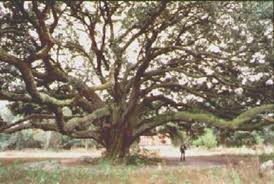
In its 453rd year, on V-J Day, August 14th, 1945, this picture was taken: 

Twenty two years later, in the oak’s 485th year, this picture was taken of the live oak itself:

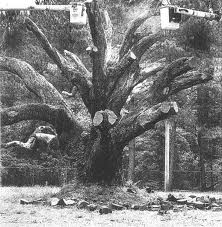
At this point the Oak, now called Inspiration Oak, had become famous and a hallmark of Baldwin County.  Though it was owned privately, Baldwin County was going through the process of buying the land for the use as a public park.  The owner was outraged at how little the County offered for the property, and purportedly was the one who, late one night, took a chain saw, and cut a ring through the bark all the way around the tree.   The community was devastated, but A Save the Tree committee was formed, thousands of doallars were raised, foresters were brought in to attempt to graft bark across the gash, AmeriCorps members organized the community, Tibetan monks came and blessed the live oak, and 15,000 visitors came a month to watch the ongoing effort to save the tree.  But it was no use.  The tree was dying.

In the Oak’s 509th year, around 9/11/2001 when our country was the victim of international terrorism, the tree died.

Two years later, in 2003, in the oak’s 511th year, the tree had become too much of a safety hazard, and it was cut down:


What’s my point?  I am not sure.  History is cool…and I like big trees…and I like old things.

JRR Tolkien loved trees. Anyone who loves history, age, myth, and all things ancient has to adore trees.  I love how they are so incredibly tied to their communities.  They are 100% committed.  They cannot move.  In the Silmarillion, the god of the trees makes Ents to protect these huge, ancient, and helpless creatures.  In the real world, Ents do not exist, and even if they did, they would be ineffective.  Humans are incredibly powerful, and can destory so much so quickly, with war, hijacked planes, or chainsaws.  We must do what we can to protect all valuable and helpless things.  Many of those valuable objects are that which connect us to our past.

I stumbled upon the Inspiration Oak story as I was looking through some of Habitat’s old National Service files a few months ago, and, for me, it immediately became a precious, rare connection to a pre-european America.  Its passing feels something like hearing that a WWI veteran died.   It strikes me in the face; so much of the past was not so long ago, and so much of what was not so long ago lives today in our homes for Seniors, our forests, and everywhere we look.  We really need to just keep our eyes open.

Beauty, specifically really cool history stuff, is everywhere.


The Modern Male Malaise

Nationwide, boys have poorer reading scores than girls, they are five times more likely to commit suicide, two and a half times more likely to drop out of high school, and, as of 2008, women accounted for 59% of all those enrolled in graduate school.  In January of 2010, for the first time in history, America had more women in its workforce than men.   There are now more females in med school and law school, two traditionally male-dominated professions.

This is not yet a tsunami.  There are different ways to look at the numbers.  For instance, more men still graduate from four-year colleges (29.5% of males versus 28% of females).  But trend projections make it seem likely that will soon change too.  In all, the image surfaces of western women on the rise and western men on the decline.

Now why is this happening?

I think there are a number of reasons.  First, people I trust tell me that the educational system disadvantages men.  It has something to do with how boys learn and how girls are better verbal processors sooner.  Secondly, I fault the lingering momentum of feminism.  Societal change has come about so quickly that many, especially those in the older generation, have not realized that it happened, and so they continue to advocate for the empowerment of women generally and everywhere as if they were still living in the 1950s.  I am for the empowerment of women, very much so.  But in broad sections of American society today, feminism is not necessary anymore.  In fact, it can be hurtful.  Generalized prescriptions quickly become stupid in a world and a country as large and complex as ours.

But what really interests me is another factor which is rarely discussed and seems to draw some ire.  It has to do with the relative uselessness of physical strength today.  Of course, strength is still useful for a number of things.  After all, boxes need to be moved and jars need to be opened.  However, such relatively meaningless activities serve to underscore how truly unimportant strength has become, especially when one ponders, just for a minute, how important it used to be.  Here we enter an alien world: the vast majority of human history.

In a world without guns, police, and communication technology, nearly all of the population existed in a state of what might be called quasi-anarchy.  Roving tribes attacked each other and the governments that did exist were not overly committed to protecting civil rights.  If you lived anywhere you likely lived within a tribe.  You would be completely reliant on the strong individuals in your tribe, specifically in your immediate family, to protect you, from wild animals, bandits, other tribes, etc., and those that could provide security naturally enjoyed a place of social prominence.

This old world was much closer to the state of nature that worried Thomas Hobbes, where life is “nasty, brutish, and short.”  It sounds awful.  I am glad I did not live back then.  But, because the challenges of staying alive were what they were, physical abilities were highly cherished.

Understanding this old world makes some sense of weird institutions like polygamy.  Today, polygamy is perceived to be an incredibly sexist institution–end of story.  But the truth is more complicated than that.  Undoubtedly, polygamy was used as a means to acquire women as if they were property, but it also served to protect women.  If you were a woman, living in this old world, how safe do you think it would be to live on your own?  In fact, women often begged men to take them in as a second or third wife when their own close male relative died.  If I was alive at the time, I feel that I would be morally obliged to acquiesce.  Does that mean I am sexist?

So, for thousands of years, maybe hundreds of thousands of years, maybe millions, men evolved and competed against themselves, as was encouraged by men and women, to better fill this perpetual need to be strong and protect.  Deep-seated cultural and genetic adaptations developed that created an abiding drive in men to address this need.  How long, do you think, does it take to undo this hardwired tendency?  If it is possible at all, I would guess it would take a while.  How long has strength been comparatively useless?  Maybe 50 years?  Unfortunately, this is the same 50 years that has seen the rise of feminism.

Of course, society has been getting progressively safer long before the 1950s, and thus women and men have been increasingly less concerned about having strength for the purposes of personal protection, especially in cities and among higher-class society and occupations.  Nonetheless, for most, strength continued to be important for work.  Sailors, soldiers, farmers, etc., needed to be strong.  To get a sense of how strength was valued, consider that in 1900, 70% of Americans farmed and lived on farms.  In 2000, that number is 2%.  Certainly, hard work is as necessary today as it was 100 years ago, but weak legs are as good as strong ones if they are simply under a desk all day.

I have been reading a biography of Abraham Lincoln.  As a youth, he became well known and respected for, quite simply, being good at splitting wood.  Almost two centuries later, chopping wood, and talents like it, are rather quaint, even cute.  Taking pride in such abilities seem childlike.  Of course they do.  Fox cubs play chase and wrestle with each other in part because it helps them develop the talents that they will need in order to survive as adults.  I imagine that our forefathers who survived a harsh world were selected in part by how their childhood games prepared them for life.  This same sort of play, the desire for children to play this way continues, but the purpose for the play is gone.  Today, lots of boys play sports, grow up, and discover that the main talents they pursued, such as physical fitness, agility, speed, coordination, are mostly useless in the real world, and the other talents that came as a byproduct of sports, such as teamwork, communication skills, and perseverance, are much more valuable.  Is it possible to switch?  Can we push kids to pursue useful things and have the byproducts be the useless skills like throwing a ball through a hoop?  Can we reform play in order to help prepare our children for being adults in a different world?  What is clear is that men have not only inherited the adaptation and desire for physical strength, we are also raised to excel in these now-useless abilities.

Really, I have no answers and nearly everything in this post is speculation.  I also should give a caveat: I am a former captain of my varsity soccer and wrestling teams.  For people like me especially, the discovery of the meaninglessness of sports and strength can be rather shocking.  It made me ask, “Tell me again, why was I led to believe this mattered?”

This much we know: it is going to be very difficult to get men to stop caring about feeling manly.  Civilizations that are successful will find ways to use this drive productively.  Fortunately, there is more associated with manliness besides physical abilities.  Maybe we can emphasize those other qualities:

If you can keep your head when all about you
Are losing theirs and blaming it on you;
If you can trust yourself when all men doubt you,
But make allowance for their doubting too;
If you can wait and not be tired by waiting,
Or, being lied about, don’t deal in lies,
Or, being hated, don’t give way to hating,
And yet don’t look too good, nor talk too wise;

If you can dream – and not make dreams your master;
If you can think – and not make thoughts your aim;
If you can meet with triumph and disaster
And treat those two imposters just the same;
If you can bear to hear the truth you’ve spoken
Twisted by knaves to make a trap for fools,
Or watch the things you gave your life to broken,
And stoop and build ’em up with wornout tools;

If you can make one heap of all your winnings
And risk it on one turn of pitch-and-toss,
And lose, and start again at your beginnings
And never breathe a word about your loss;
If you can force your heart and nerve and sinew
To serve your turn long after they are gone,
And so hold on when there is nothing in you
Except the Will which says to them: “Hold on”;

If you can talk with crowds and keep your virtue,
Or walk with kings – nor lose the common touch;
If neither foes nor loving friends can hurt you;
If all men count with you, but none too much;
If you can fill the unforgiving minute
With sixty seconds’ worth of distance run –
Yours is the Earth and everything that’s in it,
And – which is more – you’ll be a Man my son!

-Rudyard Kipling, If 


The Island of Yap

As I studied economics, I ran across this story a number of times.  Perhaps you have heard it.  It helps me think about the nature of money and valuation.

The indigenous people on the island of Yap developed money that consisted of enormous round slabs of limestone, up to 12 feet in diameter, with holes in the middle.  Limestone was not found on Yap, but on a neighboring island.  Quarry and transport costs accentuated its value.  Of course, nobody owned very many of these huge stones, called rai, but they did change hands for dowries, or as a last resort after a failed crop (though hopefully your crop was the only one that failed, otherwise you might be facing rai inflation).

But rai did not change hands per se.  They were too big.  Instead, when you acquired rai, it was merely acknowledged that the stone now belonged to you.  You left it in the town square, or marking the path, or wherever it lay.  It was yours and everyone knew it.  Now you had enduring stored value, ready for you when you needed it.

Once, while transporting a large rai stone, it fell into a deep part of the sea.  Oh no!  But after some discussion, everyone concluded it must be down there somewhere, and so it continued to be exchanged as if it was regular rai.  It is still traded, though nobody has seen it for over 100 years.

It seems to me that the brilliance of modern finance is to say, “Why are we going through the trouble of mining and transporting these stones (or in our case, precious metals) in the first place?  Seems like a waste of time.  Instead, why don’t we pretend that all our rai are already lying on the bottom of the sea?  We’ll just use banks, accountants, and ledgers to keep track of it all, just like we were doing already, but in order to lessen the impact of cycles of inflation and deflation, let’s create a quasi-governmental organization (the Fed) to control how much fictional rai at the bottom of the sea we are allowed to think exists.”  Brilliant.  If we are all going to play make-believe, we might as well ensure our make-believe world is as stable as possible.