Author Archives: Jer Clifton

About Jer Clifton

Unknown's avatar
Look up, friend. The world is too beautiful for my eyes alone.

Musings in Sri Lanka

Naturally, I am not the type who likes travelling alone, but I also love doing my own thing.  So I suppose the only solutions is to have companions and be perpetually annoyed with them.

I woke up today at 4:45AM, which is fairly good for falling asleep at 6:15Pm.  I had spent the day buying toilet paper, exchanging money, etc.  I got to walk down to the beach, which is a block away.  I ate a lunch packet, which consisted of a bag of lightly seasoned rice and a bag of curry.  It was quite tasty.

I’ve been taking some pictures, but alas, Alicia has the camera cord with her.  So I have nothing to post.  Maybe I’ll take some with my ipod : (

I came across these two quotes right before I left, and they have been welcome companions on the journey so far.

Most men pursue pleasure with such breathless haste, that they hurry past it. –Kierkegaard

If we’d stop trying to be happy we could have a pretty good time. —Edith Wharton

Peace!


50% of Cliftons Head to Sri Lanka

…the other 50% head to Texas.

Yesterday was my last day at Habitat for Humanity International HQ in Atlanta, GA.  Last night Alicia and I packed for Sri Lanka.  We’ve been camping out in our apartment for about 2 weeks on an inflatable bed, eating on folding porch chairs, washing the same dishes over and over, and making meals out of frozen edamamme we’ve had in the back of the freezer for possibly 2 years (Alicia is a genius with random foods). We went to the airport together, and now I am sitting here waiting to board for Chicago, Abu Dahbi, then Colombo, Sri Lanka while Alicia is somewhere else in the airport getting on a plane to Texas.

Alicia still does not have her VISA, but we expect it to likely get to DC at the end of next week.  She will then fly to DC, get her visa at the Sri Lankan embassy, and then fly to straight to Sri Lanka, with us only being apart for a 10 days.  Worst case scenario: Alicia’s visa never comes, I live in Sri Lanka for the summer, and she fullfills her internship requirement in Bolivia or somewhere…hmmm.  Please pray that Alicia gets her VISA soon.  We just had a very sad goodbye.  The emotion kinda surprised us both.

Otherwise, we are very excited.  We will be staying with a young lady named “Ha” in an apartment 2 minutes from the beach.  I will be chillin at the beach and exploring Colombo, Sri Lanka’s major city.  I’ll try to post some pics when I get there.


Part II: Crimes Against Criminals Don’t Count

Prison life is bad for many reasons.  This post will explore three that receive inadequate attention.   

First and most obviously, when folks are in prison, they are not in their communities.  For instance, 1 in 3 black baby boys can expect to spend part of his life in prison.  The absence of these black convicts, criminals, inmates, “low-lifes,” (aka fathers, mothers, sons, and daughters) can damage black communities, especially low income neighborhoods in inner cities.

The second reason why prison is bad has to do with how the presence of convicts in other districts takes power and money away from a convict’s own community, who often need it more.  Allow me to explain: remember how the constitution originally did not give black slaves the right to vote, but allowed them to be counted as 3/5 of a person in census data?  This constitutional law, in addition to disenfranchising people, gave slave-populated states and slave-populated counties greaterand unproportional representative power in state and federal governments.  In the same way, prisoners count as a person when it comes to districting and funding, but most often they also cannot vote.  In this way, displaced inner-city prisoners bolster the voting power of rural districts, where prisons are located, while being unable to vote themselves.  Rural whites, ironically, are statistically the most punitive demographic, and the power and money that would be allocated to inner-city, minority communities, often flows to the very districts that tend to advocate for harsher sentencing.

The third issue I want to mention in regards to prison life is rape.  In 2008, the Justice Department estimated there were 216,000 victims of rape in the prison system that year–nearly 10% of all inmates (my own calculations 216k/2.3 mil).  This was up from 140,000 rape victims in 2001 (as estimated by the Human Rights Watch).  These victims are often assaulted multiple times over the course of the year.  Consider this story:

“Roderick Johnson, a petty thief who was attacked by his roommate shortly after arriving at a Texas prison. Johnson asked to be transferred to a different section of the facility, and got his wish. But news of Johnson’s physical availability had spread throughout the complex—after you’re raped once, you’re marked—and he was soon enslaved by a gang. In addition to passing Johnson around among themselves, Johnson’s new overseers sold his ass and mouth to a variety of clients for $3 to $7, a competitive enough price that it resulted in multiple rapes every day for the eighteen months that Johnson spent in prison.”

Because of a trend of sexual slavery, 216,000 victims of rape a year might translate into exponentially more actual instances of rape.  Yet, amazingly, there were only 935 confirmed instances of sexual abuse in 2008. I am no expert, but this mind-blowing disparity only makes sense to me if victims feel that the only thing worse than getting raped is getting raped and seeking help.  By allowing this ridiculousness to continue it seems to me that society, that is you and me, is making a clear and icy statement: crimes against criminals don’t count.

Fun fact: it is very possible, even likely, that the majority of all rapes in the United States in 2008 were committed against male victims, making the United States the first country in the history of the world where men are getting raped more often than women.  Consider these premises:

  • There are around 208,000 victims of rape outside of prisons per year.
  • The substantial majority of prison rape victims are men and the vast majority of non prison rape vicitms are women, though estimates vary.
  • Imprisoned rape victims tend to be raped more often per year than non-prison rape victims, though estimates vary.

The next post will explore issues related to life after prison. 


Crimes Against Criminals Don’t Count

Crime has fallen precipitously since the high of the early ’90s.   For example, from 1980 to 2005, the estimated incidence of rape fell by 85%.  In 1990, there were 2,245 homicides  in NYC.  In 2010, there were only 536.  Crime has continued to fall even during the recession.

But this is not actually true.  Crime has merely been transplanted and concentrated in our nation’s prisons and, incredibly, crime rate statistics do not include crimes which occur in prison.  This is totally understandable, right?  Crimes against criminals don’t count!  But, lately I have pretended that they do count, which has led to some basic research about the U.S. penal system, to a discovery of an obnoxiously worthy cause, and now I am less content in my ignorance and apathy–a rookie mistake.  (If somebody can explain all this away please let me know!)

In recent posts, I noted the media frenzy around Trayvon Martin’s death and that, while the incident was tragic, murder by strangers, especially neighborhood watch volunteers, is not a top societal problem.  In an effort to walk my talk I am taking the next few posts avoiding the latest stories (Obama’s for gay marriage!?) in order to highlight the critical situation in our burgeoning penal system.  These issues receive little attention, and, in my opinion, could easily be much improved.  For those in search of a crusade, you might consider it.

Thoughtful citizens take note: the U.S. prison population has boomed (this would make a good voting quiz question).  It rose 400% from 1980 to 2007, while the general population grew 33% in the same period, until U.S. prisons housed 2.3 million with about 5 million people on parole–a total population greater than the municipalities of Los Angeles, Chicago, and San Francisco combined.  This makes the United States the most incarcarated country in the world and second most in known history (supposedly the USSR under Stalin just edges us out).  Today, the U.S. has 5% of the world’s population and 25% of the world’s incarcerated people.  We spend $70 billion of the $200 billion spent globally on keeping people locked up.

Many factors contribute to the rise in the U.S. prison population.  One is the war on drugs.  Another is 3 strike and other laws that demand stricter penalties which the public demanded after the rise in crime in the 80s and 90s.  Unfortunately, offenses that count towards 3 strike laws can be quite minor, such as stealing videos from wallmart, etc.  Life sentences are also given out more often than they used to be.  In 2003, 127,677 Americans were serving life sentences, an 83% jump in 11 years.  For these reasons and others, the prison population grew.

At first, the scale of this prison population spike just seemed strange.  After all, have we really had a 400% increase in depravity in the last 30 years?  Regardless, perhaps the rise is gravy if prison life means simply reading, watching TV, and exercising.  But the truth seems a bit more complicated. (Part 2 to come.)

(Unattributed quotes or stats are pulled from a fairly well-known article by Christopher Glazek.)


A Note to George Zimmerman

Last week’s post sparked great discussion.  It is so gratifying tackling these issues with so many friends.  Throughout those conversations, the following three points emerged:

First, as per usual, I am entirely unimpressed with the issues that the media and public choose to care about.  Obesity, to name just one issue, kills millions and costs the US economy at least $300 billion a year and is treated primarily with those two incredibly cost-prohibitive treatments: diet and exercise.

Horrible and solvable issues abound and the Trayvon shooting is not one of them.  All the ranting about this being part of a larger issue about gun control and “Stand your Ground” laws is silly.  Perhaps we will get more cases like this because of these new laws, but right now each year about 56.5% of gun-related deaths in this country are suicides, a majority of what is left is drug or gang related, only 14% of gun deaths involve strangers, and on the whole violent crime like this has continued to decline across the country since the 1980s.  The rise of homicidal neighborhood watch volunteers is not likely to be an important public health issue in the future.

Second, we must be slow to judge what happened and why it happened (this video was something that made me pause).  This story has inspired racial outrage prematurely.  Of course, it very well might be racism that killed Trayvon Martin.  If so, when that is discovered to be the case, I will agree that it is part of a disturbing, larger trend of racism.  But the trends that I see right now are an America who jumps to conclusions when the victim of a shooting is black and progressives who jump to conclusions about gun owners.  So, my progressive friends, take it from me: I find the second amendment archaic, stand your ground laws unwise, vigilanteism foolish, and the modern Republican Party upsetting.  But nonetheless, Zimmerman deserves to be tried based on the laws of his state and not your sense of what is right and wrong.  He should have his day in court and, if you are truly an open-minded liberal, in the court of your opinion.

Third, I have something to say to Zimmerman himself.  (If he is anything like me, he probably spends too much time looking at his story online, so I hope he finds this.)

Zimmerman, I don’t know you, and I don’t know what happened, but please know that I’m feeling for you man, for the fame that has rushed in on you, and for the tragic circumstances that led to it.  Two years ago, I almost hit a baby in a stroller while pulling out of a gas station.  I cannot imagine what you are going through having actually killed a 17-year-old.  And now it must seem like your whole life is out of your control and you don’t know who your friends are.  I am sorry so much has been taken from you so quickly without a conviction to justify it.

But do me a favor.  I know my little traffic accident made me think about giving up cars entirely–that perhaps it just wasn’t worth speeding around at high velocity in large hulks of metal if I could destroy something so precious with it–but I ultimately didn’t because it was too inconvenient. But you could succeed where I failed.  I am wondering, has this experience caused you to reflect anew on whether owning personal handguns is worth it?  If you came out against gun ownership right now, or even sold your own guns, it would send a strong statement.  If you don’t change your mind on guns, I respect that, but you should still think about it.  Very soon your 15 minutes of fame will be gone, your national audience will dissipate, and you will lose the chance to effect enormous change.  Don’t waste the moment. ; )


George Zimmerman and Me

One year ago this month, I grabbed the guy off the third rail at a downtown Atlanta station and my life got pretty crazy for a couple of weeks with interviews, new reports, and the story going viral online (click here if you don’t know what I am talking about).  I did not want to say it at the time, because I thought people would look down on me, but 15 minutes of fame is hard on the adrenal glands.  Sure, starving and dying of disease to death can be taxing, but watching a news story about you spread across the internet is stressful too.  Seeing facts become skewed, details lost, and misconceptions develop exasperated me.  I realized that, in everyday life, if a friend misrepresents you to someone, you can contact the friend and whoever they talked with and set the record straight.  But in a public story that millions see and thousands forward, control is illusory.  Over those few weeks I got a bit better at being comfortable being talked about by  strangers, but it left me with a healthy respect for the chronically famous, and pity for those poor souls plucked from obscurity and thrust into the limelight.

George Zimmerman is such a person.  One second he’s an insurance underwriter–entirely unknown.  Within a few weeks, protests calling for his arrest are happening across the nation and 2.2 million people have signed a petition demanding he be arrested and tried.

I was not good at interviews at first.  You can see my “men and boys” epic fail here.  But I watched  Zimmerman’s brother on Piers Morgan’s show doing incredibly well considering one guy was plucked from obscurity and the other makes a living arguing in the public eye.

From what I can gather on the awesome Wikipedia and the world wide web, people are going crazy: “George Zimmerman received death threats and moved out of his home in the wake of the controversy.[5] The New Black Panther Party offered a $10,000 reward for the “capture” of George Zimmerman;[174][175] this was condemned by the city of Sanford.[174]  Film director Spike Lee retweeted to his 200,000 Twitter followers an erroneous Sanford, Florida address, purported to be Zimmerman’s, which forced a family out of their home to avoid harassment after they received hate mail and unwanted visits from reporters.[176][177][178]

…seems a tad much perhaps?

At least I had the good fortune of being in a story that was made better by skewing the facts in my favor.  People wanted me to be a good guy.  George Zimmerman does not have that luxurty.  The story of him shooting an unarmed teenager is more sensational the more villainous Zimmerman appears.  Of course, this story is way bigger than mine ever was, more beyond his control, and responses to the story are way more cruel and uninterested in facts.

A second lesson I learned from my 15 minutes of fame is that there is no such thing.  When one-off stories like this develop, nobody is famous or known in any complexity that might reflect reality.   A thin projection of yourself, attached to your name, is sent out into the void and people judge it.

The average person feels remarkable freedom to judge people that they don’t know shit about.  They will hear a 1-2 sentence news story and say, “What a dumbass!”  It’s really quite incredible.  Really?  You’ve heard enough information?  Ah.  Absolutely.  No it makes sense.  I’m sure you are very intuitive. 🙂

As friends and I discussed the Trayvon Martin shooting, I was very surprised at how such kind and thoughtful people can also be so quick to judge.  I am amazed at “facts” that people are citing, in my own conversations and in the news, that are so obviously inconclusive and meant to paint a picture.

For instance, it is oft said that he apparently has called the police 46 times since 2004 — but I probably called the police twice as many times in my 2 years as a community organizer.  He also was part of the block club, and was tasked with the neighborhood watch.  Some say he was a busy-body who took it upon himself.  Others say he was asked by the community to do it.  I say that if you walked down any block that I had worked on, you would probably hear both things said about me too.

So, as far as I can tell, Zimmerman might be a vigilante idiot.  He also might be a responsible and active community citizen.  I don’t know.  But I do know that nobody else knows either and that all the facts that I know about the case, including the skin color of the victim, might be incidental and not reflect the mind of George Zimmerman.


Pandas – Epic Fail

I recently read a short story about pandas, watched 2 documentaries on pandas, and enjoyed Kung Fu Panda 1 and 2 .  In my newfound expertise, have come to the conclusion that pandas are entirely pathetic creatures. First off, 99% of their diet is bamboo–delicious and not at all nutritious.  A true bear, they have carnivore specific genes, carnivore teeth, and a carnivore digestive system, so they derive even less energy and protein from their food.  They can’t hibernate for the winter because there is no way for them to store up enough fat.  They don’t like moving around much.  And they avoid mountains because it takes too much energy to climb.  Males weigh up to 350 lbs.  Females up to 280.  They eat 20-30 lbs of bamboo shoots a day and can poop, with all that good roughage, up to 40 times a day.  The rest of the Panda’s diet, the 1%, is other grasses, wild tubers, small birds, rodents, or carrion.

Pandas have very short life spans and sexually productive periods.  They lose interest in mating once captured.  Even in the wild they can’t raise more than one cub at a time–if more than one cub is born one is left to die–because their milk is so low in nutrition.  And the cubs need nutrition.  They start out pink, blind and furless, at a whopping 3.5-4.6 ounces.

In contrast, black bears weigh around 300 lbs and will eat nearly anything.  Polar bears eat almost nothing but meat and weigh up to 1500 lbs.  Grizzly bears also weigh up to 1500 lbs.


When my brother was in ninth grade he told me something that has stuck with me.  The best stories are those in which normal everyday people discover something about themselves, something special, some heritage, special skill, or destiny, that launches them into a life of adventure, excellence, and self-fulfillment.

I guess I am waiting for the Giant Panda to remember it’s a kickass bear.


Cliftons Head to Sri Lanka!

My job with Habitat for Humanity International ends late May and at nearly the same time Alicia will be starting an internship with Oxfam in Sri Lanka.  Last summer she went to Rwanda without me, which was horrible, and stupid, and 10 weeks long.  So Alicia and I decided, “What the heck!  Let’s pack up our apartment, put it in storage, and both go!”  Afterwards, maybe we can get to Hong Kong and see my Dad, brother, sister-in-law, and nephews, maybe I will get a Masters in Positive Psych at Penn, maybe we can get jobs in Sri Lanka, maybe my book will get published, maybe we will sail…who knows.

So, for the past couple of weeks while this decision process has been more realized, I have been learning about Sri Lanka.

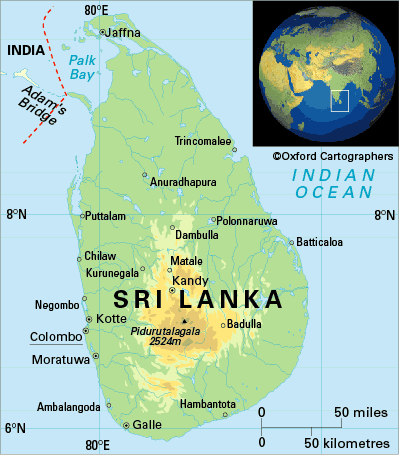
Sri Lanka is personally interesting to me because of three very strong similarities with Taiwan: they are both substantial islands off the coast of emerging superpowers, they both have booming economies (Sri Lanka had Asia’s fastest growing stock exchange in 2009 and 2010), and they both have a bit over 20 million people (Sri Lanka has 21, Taiwan 23).

They have plenty of differences.  Taiwan’s mountains are about 50% taller than Sri Lanka’s though Sri Lanka’s landmass is twice as large (12,966ft to 8,200ft and 36,000 to 66,000 square kilometers).

One of the big differences is that instead of tensions with its emerging super-power neighbor, Sri Lanka has struggled with ethnic strife internally for the past 30 years in a conflict which has killed about 90,000 people.   The conflict has been between the Tamils in the North and East concentrated around Jaffna and the Singhalese that cover the rest of the island.  The tactics which the Tamil Tigers or LTTE (Liberation Tigers of Tamil-Eelam), a political party, has used has led to them becoming officially recognized as a terrorist organization by 32 countries, including the United States, India, Canada, Australia, and the EU nations.

After numerous ceasefires and resuming of the conflict, the war seems to have ended in 2009 when the LTTE admitted defeat after a coordinated strong offensive by the Sri Lankan government.  Today, a separate state for the Tamils on Sri Lanka looks unlikely.

I’m so excited to learn more about the conflict and the country!  We will be staying in Colombo, Sri Lanka’s biggest city.  Alicia will work during the week while I write and plan weekend trips. : )  I will probably spend some time with Habitat Sri Lanka too.  

In other news, I have been devouring more lecture series lately:

  • “Naval Battles that Changed History,” –There have been surprisingly few very important naval battles but they were nevertheless very very important.
  • “Fueling the Planet, the past, present, and future of energy “– Where I was told that carbon emissions are a big problem.  He seemed to think that wind power was especially promising.
  • “Wars that Made the Western World” — Professor Shutt is always solid.  He discussed the Persian Wars, the Peloponnesian Wars and the Punic wars, and I learned even more about Alcibiades, likely the best-looking, most conniving, most brilliant man ever.
  • And now I’m working through a history of the Papacy and another one on the Crusades.

I’m looking forward to sharing with my readers all this cool stuff I’m learning about and keeping you updated on our trip to Sri Lanka.   My posts will likely become more frequent now (1-2 times a week).  Thanks for reading!


How One Lawyer’s Mistake Changed History

I have always thought that if it were not for Clinton’s sex life, Al Gore would have won in 2000, Gore probably would not have invaded Iraq, the U.S. would probably have better environmental policy, and the world as we know it today would be different and likely better (I’m not the biggest Bush fan).  From time to time it strikes me (and I define “strike” as a “holy shit!” moment which raises the eye brows to their maximum height for a solid five seconds) how one person’s libido could be so geopolitically potent.  But apparently, though Clinton’s private behavior was scandalous, it was not potent enough on its own to change electoral history.  For that, credit goes to Clinton’s lawyer.

I was only 13 when the Lewinsky scandal story broke, so it has always been, as many news stories you hear when you are younger, a collection of unanalyzed facts in my head, such as the theory that bridges crossing water are maintained by government enslaved turtles which your brother pedantically explains to you when you are four years old which makes you inexplicably sad as as you drive over bridges as an adult.   Gleeful liberation comes from taking a half-second to discover these pockets of unanalyzed thoughts and, in many cases, going through the process of having an opinion, reversing it absolutely, being strangely ashamed of your former opinion, and doing it all so nearly simultaneously that you guffaw, give a high pitched “hee hee,” and sigh happily in rapid succession.

In recent years, I subjected the Clinton scandal to a half-second analysis which left me wondering, “Why in the world did a sitting president testify under oath about his sex life?”

So I was excited that while going through a 14 lecture series by Alan Dershowitz, called “Fundamental Cases of the 20th Century,” I heard the full story.  I would recommend the series.  He deals with all the major trials, as well as a number of trials in which he personally played a role, including the O.J. Simpson trial, the Mike Tyson rape trial, Claus von Bulow‘s alleged murder of his wife Sunny, and some others.  He’s articulate and not afraid to share his opinion when he can.  For instance, Dershowitz blames Clinton’s impeachment on Robert Bennett, Clinton’s lawyer, awarding him the coveted prize of having made the biggest legal mistake in the last century.

In short, Clinton was being sued by Paula Jones, a former State of Arkansas employee, for sexual harassment.  Clinton’s lawyer instructed Bill Clinton that he had to testify under oath about his sex life, and Clinton did as he was advised… and that was the ball game.  However, Clinton did not have to give that deposition.  He could have settled (he ultimately was forced to anyway).  He could have been charged with contempt of court.  He could have easily given a public statement saying that preparing to give a deposition takes too much time, and that he was willing to settle and move on in order to get on with the important business of the country.  In other words, though it would have been a little bumpy politically for a few days, not giving a deposition on his sex life would have worked.  Apparently it is really hard representing powerful people because you have to tell them things they do not want to hear such as, “you obviously can’t speak truthfully and acceptably about your sex life.”  So I suppose it was Bennet’s lack of cajones, rather than Clinton’s overabundance of them, that led the nation down this causal train.

Incidentally, years after the impeachment, Alan Dershowitz talked to Clinton about it at a party.  Clinton shared with him that Bennett never gave any option except testifying under oath about his sex life.

Since childhood, I had always assumed the president had got into trouble for lying just like 13 year old Jeremy might get into trouble for lying.  But apparently, lying does not automatically mean you are in trouble with the Feds.

GUFFAW, heehee (high pitched), sigh.

The end.


Support the Arab Spring!

Last week Alicia and I went to a CNN forum at Emory about the future of the Arab Spring.  I thought it was good but there was a suprising amount of technical issues, the topic was a bit broad, the moderator was prone to cutting off good discussion, and when Alicia and I rode the scooter home we froze our little butts off, but that last part probably had less to do with the forum than other things.

Two people on the panel stood out that I want to put on your radar screen.

Dalia Ziada is director of the Egypt office of the American Islamic Congress which focuses on building interfaith and intercultural understanding.  She is a published poet and active in pro-democracy politics.  


Lamees Dharif is an award-winning journalist and activist who has been active in the Bahraini resistance campaign.  She has been banned from writing by the Bahraini government since the beginning of the democracy movement there.  

There was some discussion about the relative immaturity of democracy exhibited so far in the region and that people in America and elsewhere were worried about how long it was going to take for the situation to stabilize.  Lamees provided the metaphor that if a man is in a coma for 40 years, he does not wake and go for a run.  No.  It takes him a while to find his bearings, to re-learn how to feed himself, walk, etc.  But eventually he will run.  So it is with the middle east.  When people have languished under corrupt and totalitarian rule for so long, of course it is going to be a long time before the culture and intsitutions of democracy become realized.

I would take it further.  Americans who criticize the Arab Spring as creating instability are hypocrites and cowards.

Consider, in 1775 we started fighting our Revolution, two years later the States entered into an agreement under the Articles of Confederation.  We won the revolution in 1781 and we remained under the articles of confederation for 8 more years until 1789.  It was only then that we adopted the Constitution.

In other words, we operated under a system of government that was broadly understood not to be working for 12 years, and after that things still took a while to stabilize.  Our economy was in shambles.  Our money was worthless.  Did you know that States were leveraging tarrifs against each other.  States were violating the peace treaty with Great Britain, but the federal government could not do anything about it.  In the meantime, other nations rode roughshod over this toothless and inneffective American government.  Great Britain ignored various aspects of the treaty of Paris.  They kept warships in American waters for years!  Spain closed the Port of New Orleans to Americans in 1784 and the Americans could not do anything about it.  To top it all off, in 1787, Massachusetts farmers under the leadership of Daniel Shay revolted because they could not feed their families and their  homes were being foreclosed.  They captured the arsenal at Springfield and marched on the Massachusetts legislature.  Washington called it, “Liberty gone mad.”

Additionally, the instability that Americans generated in their own country was exported all over the world.  Over the next 20 years revolutions broke out in Haiti, Batavia, Brazil, Argentina, Chile, Peru, Bolivia, Ecuador, Venezuela, Mexico, Ireland, Poland, and most famously, France.  In fact, “Atlantic Revolutions” is a blanket term for all the revolts that happened during the late 17th century.  Or you might call it the “Atlantic Spring.”

We were Egypt in the late 1770s and King George III was Mubarak!  Americans are at the apex of hypocrisy and selfishness when we refuse to support, diplomatically at least, the people rising up to challenge oppressive rulers because we are worried about paying a couple bucks more at the pump.  Additionally, we need to understand that we have supported, in many cases, these totalitarian oppressors ourselves.  I love America, which is why reading the history of our relationship to the Middle East for the past 80 years is depressing.

Finally, revolutions are what I thought conservatives wanted.  Wasn’t this what the second Iraq war was ostensibly about: encouraging democracy around the world.  Was there not instability and confusion in Iraq?  In general, the negative reaction of conservative talking heads to the Arab Spring confuses me.  Maybe these revolutions are tainted by the fact that Obama is in office?  I’m not sure.

Realistically, we should expect the Arab revolutions to make the region messy and unstable for some time.  Nonetheless, we must support them any way we can for however long they need it.  No matter how I look at it, it seems to be, quite clearly, our ethical obligation.